
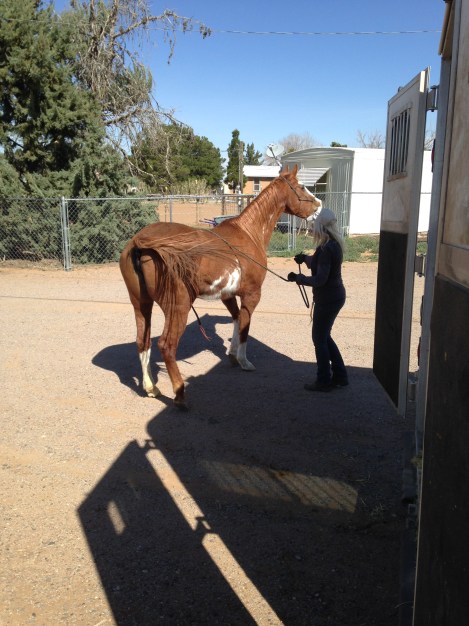
Whenever horses are transported, for competition, to get medical care or even in an evacuation; we can prepare ahead for safe travels with a few guidelines and good habits.
The fact that a horse will get into a trailer to be driven from one place to another is a testimonial to that horse’s trust. We must honor such trust by making the trailer itself as safe as possible and by driving the horse around in a sane and aware fashion. We need to have schooled our horse to calmly load into the trailer and it is advisable to show different types of trailers and vans to a horse so that unfamiliar rigs won’t be frightening in an emergency.
Loading into a trailer can be enhanced by opening light sources, hauling with a trusted equine companion, staying calm (by giving plenty of extra time before needing to be on the road), having hay or a mash in the feeder, shavings on the floor to muffle sounds and teaching in-hand skills ahead of time (horse will walk over tarps, plywood and rubber mats; he will walk forward from verbal cues and can be touched all over with a wand/whip that can ask him to move sideways).
The floor of the trailer may well be the most important part. If the floor the horse stands on has any weaknesses, tragedy can result. I always take a strong pocketknife and jab it into the floor boards at several locations. If the knife slides easily into the wood, that floorboard is not safe (it is probably rotten). Any wood rot means the entire floor should be replaced. By cleaning out the trailer stalls after every trip and washing the floor, then drying it, we can make the floor last longer.
The next inspection point needs to be for any protuberances, sharp edges or gaps (that a hoof or head could get stuck within) that could cause bodily harm or panic. I also always look for wasp nests, spider webs and the like where a venomous creature might hide! Those must be removed before a horse or human gets into the trailer.
Hitches, balls and electrical connections should be working properly. Tires need to be inspected and tire pressure checked. A spare is a necessity and jacks/wheel chocks, lug nut wrenches, even flat fix should be handy. I carry extra halters and leads, first aid kits, water (in an Aquatainer), buckets, flashlights, lavender essential oil and Bach Flower Essences’ Rescue Remedy.
The floor of the trailer needs rubber mats to provide traction for the horse. The movement of the towing vehicle and trailer is extreme for the standing equine and any slick surface is dangerous (I once linseed oiled the trailer floor boards to preserve them and the rubber mat slid out from under my mare!).
Ventilation in the trailer is essential for the horse’s health, no matter what time of year. Horses exhale and sweat a lot of moisture into an enclosed space and can make it oppressive quickly. In winter, leg bandages and blankets can keep the horse warm. In summer, open every single vent there is and be sure to provide drinking water as often as possible. If you use a slant trailer and leave windows open (never leave them folded down, horses can try to crawl through openings), put fly masks on horses to protect their eyes.
There are many articles of protective clothing for the traveling horse. Tall horses can wear “head bumpers” which are cushioned helmets that protect the very vulnerable “poll” at the top of the equine head. Shipping boots or bandages protect the legs and “bell boots” protect the hoof and heels in case the horse steps on himself. Rubber hoof boots can add more traction and a bungee or “safety” tie to secure the horse by the halter is a practical method. Always tie horses with a quick release knot that can be untied with one swift tug.
Providing hay (we soak it in some water just before) to munch can be calming for the horse and keeping his gut working is a healthy choice.
Drive your rig with awareness of the animal trying to balance inside. Pull out and stop gradually; go slowly around turns and corners. A horse can become difficult to load and haul if every time he rides in a trailer he is miserable or terrified.
Use common sense when traveling. Never unload horses beside a busy highway. Do not let a horse graze (nor pick grasses) from the side of roads where pesticides are likely to have been applied. If you are on the road and the horses become upset in the trailer, pull over and let some traffic go by. Some vehicles (and often motorcycles) can have the little high pitched sound “whistles” mounted that serve to chase deer away from the road. These sounds can overwhelm a horse.
Load and unload him in the trailer with awareness of his feelings and according to the type of rig. If he is tied in the stall of a “straight” load trailer, always untie him from the front before opening the rear door and butt guard to unload him!
When you have to back up your trailer, hold the bottom of the steering wheel and move your hand slowly in the direction you want the trailer to go. Back up very slowly, making corrections slowly. If the rig tries to jack knife, pull forward to straighten up and start over.
Hauling horses can be a “snap” if you think ahead, prepare and stay focused on safety.


 Stablewomen