
I have a notebook from the 99cent store that says on its cover, “REFINDLY MADE FOR THE SUCCESS OF YOUR OUTSTANDING CAUSE”, just like that all in caps and with two strawberries (I think they’re berries…) to the left. I found it the other day trying to reorganize the office. Three pages in, I had written “Smelly Things” and listed, with bullet points, things that smell.
And, just a couple of days ago, a friend had her dog at the Veterinarian. Her young dog had been vomiting and had loose bowels; the Tech asked her wait outside, that it might be Parvo (it was not).
Yesterday, we had the equine dentist here floating teeth. He stopped a few times to smell the saliva on his hands for infection (I do that, too). I’ve been smelling LungTa’s (the Irish Draft horse) hoof with the abscess and finding the exudate to stink less and less.
All of these things have pointed me toward writing something about odors and their markers, so I decided to do so here. Most of us probably do a lot of discernment through our olfactory observations. I find myself to be quite sensitive to aromas… except perhaps the glorious smell of horses that others comment upon when arriving at the stable yard! Or the scent of Patchouli oil that I use making my own deodorant (apparently, I’ve gone nose numb to patchouli and must be reminded by others when I start adding too much).
I had a wonderful Vet named Skip who was also a friend. He has retired, but he often diagnosed firstly by scent. He and I could definitely smell Paro Virus (I learned it from years of Teching at an animal hospital and then when raising English Setters). He knew that cancer had a scent (there are dogs who can smell cancer, they say). I learned that particular marker, unfortunately, through the decades of rehabilitating horses.
Necrosis in wounds has a marker – the smell is probably familiar to most. And it is not host specific… people, dogs, cows, etc. as well as horses will have that similar stench when a wound goes septic.
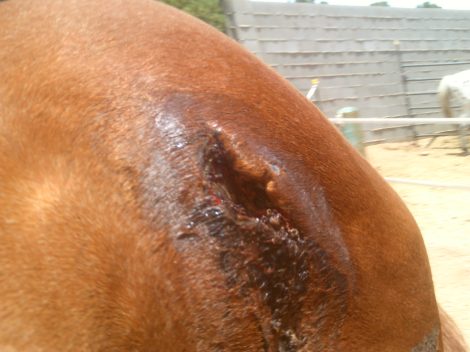
That first whiff of stink can help us get to better treatment quickly, before the systemic infection sets in and the animal spikes a fever.
I am fully aware that this topic is not one to peruse over breakfast or share with a squeamish young daughter, but it is a subject worth noting because there are some life saving possibilities tied to the ability to denote subtle smells around us.
The horse’s poo can give us valuable insight into his health and the condition of his digestion. Beyond just the look and consistency (which, mind you, are vitally important), the odor from a bowel movement will have volumes to say. If the odor is sour and pungent, the horse likely needs probiotics. If it is a “meaty” smell, the diet should be checked and activated charcoal fed to detox the gut (there could be animal products in the feed or digestion is slowed or the gut has become permeable to the horse’s own blood). A sulfur smell can point to hind gut motility changes or simply come from sulfur rich herbs being fed (or MSM supplements).
Urine odor has its own story to tell. The stronger it smells, the more likely it is that the horse is not drinking enough water.
The horse’s sweat odor can have markers we should be attentive about. A stinky, urine-like smell can actually be tied to the kidneys not filtering properly. A sweet odor can be a warning about other organs and a foamy, thick sweat that smells like manure can signal dehydration’s arrival. This can indicate the need of electrolytes or even just salt deprivation (horses need free choice plain salt year round).
If the horse’s breath smells sweet and like a meadow, he probably has a healthy mouth. If there is any sour, foul or fermented smell; infection, improper mastication of food or injury could be present. These observations serve us, not so much as diagnostic tools, but as a pre-signal, a warning that we need to pursue a diagnosis. Catching a malady early can reduce damage, make treatment simpler and sometimes, save a life.
I have a whole detailed analysis of my own perspective about smells (with bullet points!). It is useful for me as a reminder to stay aware and I was so pleased to discover that I had not thrown it away. And the opportunity to chat on about the topic here just might help someone who is thinking, “Crikey, what’s that smell?” It is a message. Indeed it is.
 Stablewomen
True that! I so often find myself in a cafe’ talking about a hoof problem or a horse’s poo and then see people looking my way… but, I feel that I live a “real” life! 😉
Oh yes, smells most important! And what do cats in particular do when they have eliminated? They turn around and smell it. Diagnose which herb etc to eat, most sensible. Good example that I’ve followed, although I’m guessing it’s not something that ‘genteel’ women discuss 🙂