Monthly Archives: June 2023

Home

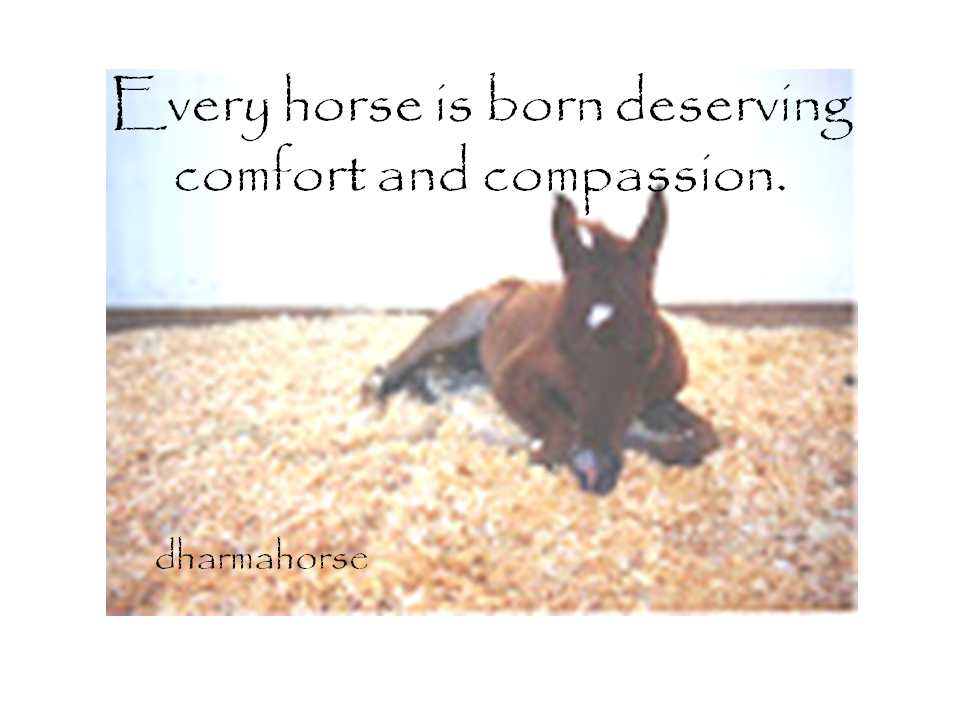
Decades ago I made a pact with the Universe. Every horse who came under my “ownership” (stewardship) would have the best life I could provide and a new good home if that was what the future brought for them. I kept a lot of horses from birth to death, but many more horses and some mules moved along to loving homes for a plethora of reasons. My brother and I made a list in the ’90’s of the horses we had owned – after remembering the names of 300+ horses, we stopped counting…

That sounds like we were turning horses over “right and left”, but the reality was, I bought, trained and sold dozens. I ran three schools of horsemanship from 1973 to 1997 and continued to teach after that. Dozens of school horses worked with me. Sometimes, a better type of home was found for some. At times, a horse proved to be more suited to “family life”. I rescued horses from dire situations… I started my 4th school in 2010 here in Las Cruces and it morphed into this Sanctuary.

During all those years, I made some mistakes. One time, when I had to move to Arizona, I gave a horse I had raised to a lady I thought would be the perfect home… she could handle him, I knew that. He was complicated because he was orphaned at birth. They are never easy because they model after humans instead of other horses.

When I returned to New Mexico, I learned that this horse had been for sale, had not sold and was going to auction! Friends bought him to save him. He was difficult for them to handle, so I found a woman who I had worked with in the past who had known and loved him. They gave him to her, and it was a perfect match. He was safe.
We do the best we can. I learned that a horse sold for a lot of money would be “worth” more to the buyer than a horse given away, no matter the circumstances or the horse’s abilities. I learned that people’s lives can change and their priorities change. In the rescue world, we can adopt out lots of horses to make room for more intakes – but making sure the adopted horses continue to be cherished isn’t easy.

We all have contracts that stipulate an adopted horse is to be returned to us if it doesn’t work out. I am so grateful that our adopters have honored that. But many times, for friends of mine, it has not gone that way.

At Dharmahorse, we have so many senior and special needs horses. They stay with us for the rest of their lives. Of course, that means they die here. They are cherished and cared for – sometimes in heroic ways – through their last months, weeks, days… even hours. Crickey, it’s not easy. But I’ll tell you what is harder. It is much more painful to learn of a horse who had been in your care who was ridden into the ground, ignored, brutalized or left to suffer. No matter how you try to keep tabs on them, horses can fall into at-risk situations in the blink of an eye. So, these beloveds stay with us. They stay as long as the quality of their lives is good and their day-to-day existence is worth living. If a rescued horse had been dumped in the desert, starved, brutalized or injured, to put them at risk of falling into that same situation would be unconscionable!

Decisions are very much made “in the moment”. The passing of a resident (the last euthanasia’s here were horses aged 35, 42, 40 and 31) will make room for an equine who needs us. And intake is decided from a 2-page list of criteria… and a Board of Directors meeting, even if it has to be virtual.

Rescue/Sanctuary isn’t easy. Sometimes we are a “nursing home”; sometimes we’re hospice. Always, we are home for these horses.

Categories: Uncategorized | Leave a comment

Help a Horse Learn

Horses learn to anticipate movements, transitions and such when we are riding.  They anticipate places on the trail where scary experiences have happened to them.  They anticipate being fed or turned out at specific times.  They are creatures of habit.

We can use this to help the horse in his schooling.  And by understanding his need for routine and the way in which he forms habits through anticipation, we can avoid habits that we don’t want him to manifest. We are responsible for the habits our horses form because they are either learning or unlearning.

Under saddle, we can use “props” to help channel the horse’s energy and keep his attention.  Soft plastic cones work well.  I buy inexpensive ones in different colors (to help my human students) at a soccer supply store.

So if you have a horse that is nervous or distracted about riding out away from the stable, start teaching him to do serpentines around six cones in a line at the walk.  It helps to have an assistant on the ground, but you can do this alone with preparation ahead of the ride (and two sets of cones). I used this exercise with a student whose horse was terrified by a neighbor’s garage door opening just as she rode him out of her gate! She was also frightened by the experience.

When your horse has become very calm about the cone serpentines (over several days) and finds it habitual to focus on them, put the cones in a similar line outside of the stable on the trail.  Go a very short distance at first.  Walk the horse on the same serpentine around the outside cones.

In time, you will have your assistant pick up the first cone (nearest home) and take it to the end of the line (furthest from home) while you continue walking around them.  You will continue this exercise as long as the horse remains focused upon the cones, the serpentine and your aids.

If he gets distracted, make the figures smaller or more complicated and do not extend the cone line any further out.  You will do this quietly over a long period of time.  The horse becomes complacent about the whole thing, and you can eventually set the cones in a line way out from the home and ride to them.

Your horse anticipates the serpentine when he sees the cones.  In this way, his energy is focused upon the turning movement.  You are using his anticipation of the quiet figure to defuse his nervousness.  It will also help a timid rider keep her aids on the horse when riding out.

Cones can be used to help horse and rider with spirals at any gait.  You need at least eight cones.  Set them in fours at the “corners” of the concentric circles of the spiral: you will ride outside of the main four cones (I call this the “large” circle), in between the path inside of the main cones and the smaller circle created by the other four cones (this is the “medium” circle), and the “small” circle inside the last cones.

If each group of four cones has its own color, that helps the rider.

If your rider starts riding squares instead of circles, add more cones to actually shape the circle for her.  You can ride large, then medium, then small to spiral in.  Then ride small to medium to large to spiral out.  While the spiral itself may not step as much laterally as it will later without the cones, getting this exercise accurate in its shape and concept is so much easier with props. 

I have a student whose entire property in on a slope.  She is either riding uphill or downhill.  She has long, wonderful sand arroyos where we place pairs of cones (just like empty jump standards) randomly through the area so that she and her horse must focus on the middle of each cone set and ride, at each gait from one to the next.  This particular exercise helps her with her youngest horse’s canter work.  He maintains his rhythm and impulsion better by having to focus on the next “obstacle.”  She does this without the lead changes right now, but they will come next; first simple changes and, later, flying changes.

We do leg-yield zigzags and half-pass zigzags up and down the arroyo at each gait.  This establishes much needed balance and concentration for both horse and rider.

Another exercise with cones is to create a square with a cone at each corner.  You can rider into this cone square at each gait, halting within it.  Your horse will anticipate the halt and become more focused upon your aids.  The square can be the center of your figure-eight (two circles connected at the middle) and, in this way, you will work the horse equally to the right and to the left.  You are using the props to help teach the horse to listento your aids.  He will learn that something is going to happen within the cones and will get ready for it with you.

After your halts become soft and even, ask for only half-halts with a strong driving aid right after.  Your horse will learn to re-balance himself easily from the half-halt.

When your horse begins to anticipate too much, you change tactics and begin to leave him guessing.  You will ride past the cones, ignoring them.  You can do a different transition each time you pass between cones.  All you have to do is use the horse’s habit-forming nature to help him learn and be on guard against habits that you don’t want him to have.

Anticipation is the very reason a horse can become so light and so tuned to the rider’s aids that he appears to move of his own volition.  It is his awareness of the subtle shifts of his rider that lightens him.  But to get there, the rider must be consistent and every movement she makes must have meaning to the horse.  Otherwise, he learns to ignore everything but the most blatant signals.

Categories: Uncategorized | Leave a comment

Blog at WordPress.com.