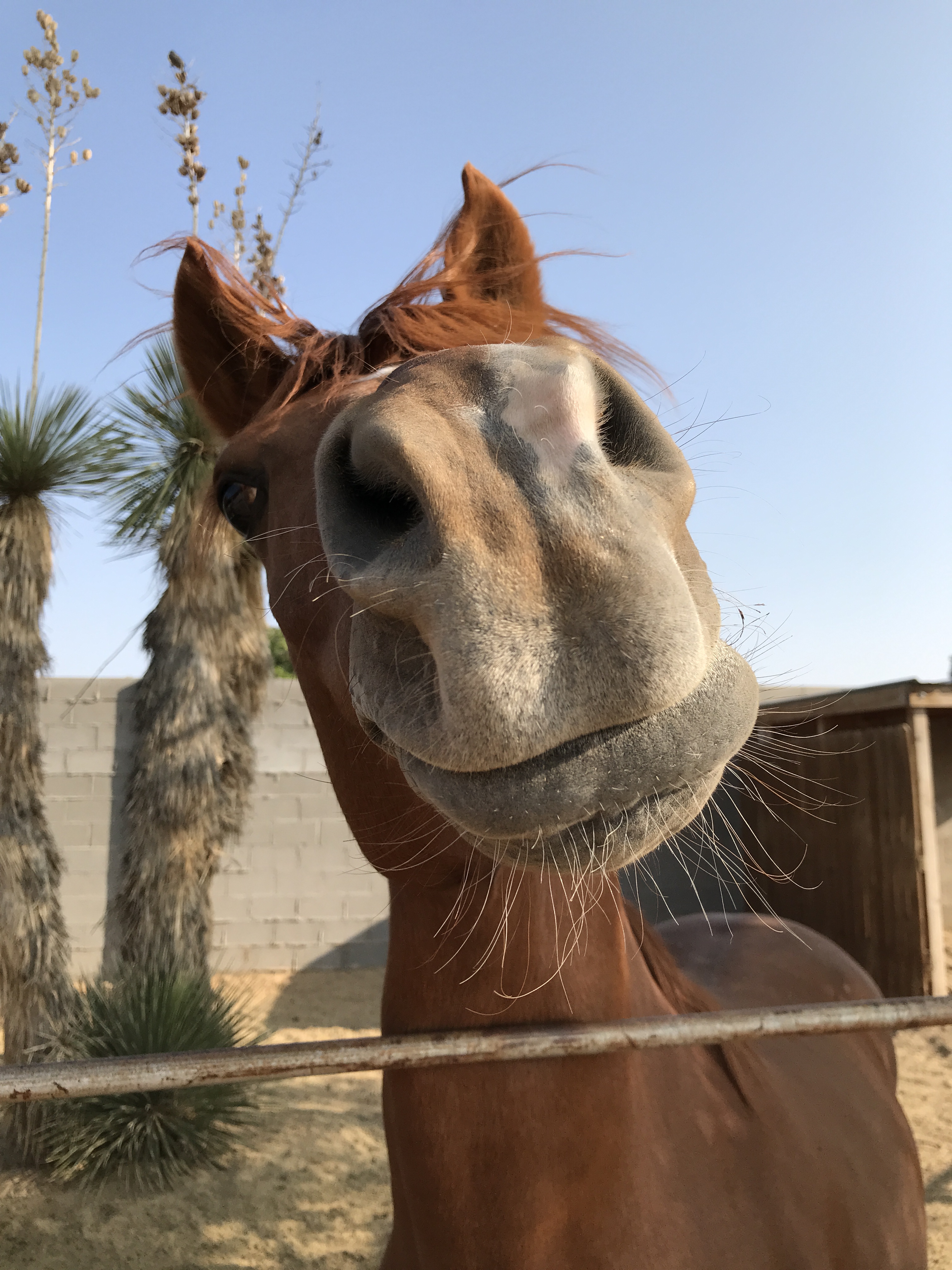
I am feeling keenly aware of the disturbing nature of miscommunication in my own life and this makes me think about how we need to maintain clarity, consistency and compassion in our dialog with horses.
My phone went down and the calls to me were broken up into hearing every third or fourth word. This is likely how we can sound to our horses when we are working with them and become distracted or simply inconsistent with our requests. It can be difficult enough to communicate with a member of our own species in a shared language, let alone try to convey our desires to a thousand pound prey animal whose instincts tell him that we are predators.
How we accomplish the almost magical feat of rapport with a horse is by not only putting our desires forward but by listening as well. And when we work with a new horse, it is imperative that we find out as much as possible about how that horse was schooled. This will help us avoid triggering fears (in a horse who perhaps was in a wreck while riding in a trailer), confusing the horse (one might neck rein in western style, another may direct rein in English style) or simply asking more of the horse than he has been prepared to do.
Communication with a horse is actually dialog and not the mechanistic force of signals used as if driving a car or riding a motorcycle. The dialog must be clear so the horse has no doubt that it is meant for him. We must get fully present to engage with a horse. If we are not, his realization of that fact will keep him distant emotionally because he can only be as present in the moment as we ourselves are present.
Consistency is the real key to gaining the horse’s respect and attention. If we allow something, such as eating grass on a trail ride; then the next day we “punish” the horse for eating grass, and allow it the next day, we will set up confusion and disrespect. We must “be the same person” day by day. Equine mental health is absolutely tied to how calm, compassionate and consistent the human handler remains.
My advice when anyone acquires a new horse is to ask the previous humans about not only diet and exercise programs, but to ask things like if the horse ties or needs a quick release snap; does the horse stand at a mounting block; does he accept being sprayed with fly repellent; those type of questions (considering your own plans and routines) can help to avoid some serious, even dangerous miscommunications.
And we can always change an equine’s routines and responses; we just must remember to do so gradually and with clarity, consistency and compassion. One cannot take a horse who is used to having his stall door opened, allowing him to run out on his own, and expect calmness when we try to catch him and lead him out instead. He will be a product of his conditioning and habits and these can only be changed by teaching new habits as substitutes. Therein lies understanding, safety and rapport.
Most minor injuries that horses receive are of the bump or scrape variety and can be treated at home by an owner. When large areas of skin are removed or deep wounds cause profuse bleeding, the Veterinarian must be called at once. Things like non-weight bearing of a leg, inability to move forward, extreme distress in any form are also emergencies.
For simple, acute injuries at home, cold running water is the treatment of choice. Ice can actually damage tissue if applied for long periods and heat exacerbates the swelling at a fresh injury, which impedes healing. Bruises and wounds that have stopped bleeding can have a low stream of cool water from the hose run over them for up to an hour with beneficial effect (we suggest doing so under a tree to keep from wasting water).
Horses can receive heat, friction or chemical burns and the cool water is often a good choice for those, after consultation with the Vet. We make our own herbal ointments with calendula infused olive oil, melted beeswax and lavender essential oil. This is used on any dry, abraded or old wound. We use organic, powdered rosemary herb on weeping, wet or lower leg wounds (this forms an antiseptic scab).
A wound that is bleeding heavily needs pressure applied while waiting for the Vet. Such wounds on the leg can be bandaged with a leg wrap over a clean pad. Body wounds need hand pressure over a clean pad or towel.
With objects stuck in an eye or a hoof – it is best to leave it in place if no further damage will occur. When the Vet arrives, she will be better able to assess the situation and remove the object properly. When a horse gets cactus spines or splinters in his skin, we use Icthammol ointment to draw the spines to the surface.
Become familiar with your horse’s normal mannerisms and vital signs (pulse, respiration and color of mucus membranes) so that a deviation is easy to spot. A dehydrated horse will have tight, dry skin that does not “snap” back when pinched on the neck. Pink gums are healthy; yellow gums are an emergency (signaling liver trouble); bright red gums can indicate stress from exertion; blue gums are an emergency (signaling heart, renal or respiratory trouble); white gums could mean anemia or shock.
First aid for colic (digestive trouble) while waiting for the Vet can include slow walking in hand, gently pulling the horse’s ears from base to tip and covering the loins with blankets in cool weather.
For bruises anywhere on the body, we apply comfrey root infused oil and if we suspect bruising of the hooves (say, after a trail ride) we dose homeopathic Arnica Montana pellets in pieces of apple. For pulled tendons, we dose homeopathic Ruta grav. For joints we use homeopathic Rhus tox.
Any blow to the head is an emergency! Any potential back injury is also! These require keeping the horse calm and still until the Vet arrives. If you see any swelling of the face, insert a soft piece of hose/tubing into a nostril since horses cannot breathe through their mouths.
In emergencies, remain calm, handle the horse safely while you wait for the Veterinarian and be sure to give her all the information you possibly can so she can arrive prepared.
“No hoof, no horse” is a saying that has been around forever for a very good reason. Our horses rely upon the foundation of healthy hooves in the same way that a building relies upon its foundation – without a good one, everything above is compromised.
The hooves, like all body systems, are created from the foods ingested. Certainly external forces are at play as well, but, without the complete nutrition needed the hoof cannot meet these forces with strength and flexibility.
Horse feeds came about at the same time with the same philosophy as livestock feeds which were designed to create muscle and fat for meat production. The goal was the feeding of muscles and creation of fat layers and slick coats, along with energy for working in fields and on roads. Horses did not live very long and a preponderance of draft blood made for larger, better equipped hooves as foundations.
Our horses now are family members living longer lives, often with smaller hooves from the breeding of lighter types for sport or show. While proper trimming is absolutely essential – the creation of the hoof structure, strength and health will be determined by diet.
The horse, being designed as a browser/herbivore requires the high fiber diet filled with herbs and forage that Nature provides (we can provide this, too!). To “feed the feet”, we need to supplement the grassy pastures and/or hays with herbs and foods that support hoof health by providing minerals, amino acids, enzymes and safe lipids (fats).
To process and extract the components then provide them in a bag of “complete feed” can often corrupt the very nutrients that are desired. Heat destroys nutrients and most processed foods are created by steaming or cooking. Chemical extraction is used to isolate many nutrition oils before they are blended into feeds and the result is a less digestible lipid with potential residues of the extracting agent. Just as processed foods leave us feeling hungry because we’ve eaten “empty calories”, the horse will feel undernourished and seek roots, barks even eat dirt in an effort to find what his body craves.
Foods that are grown with chemical fertilizers, pesticides (herbicides or insecticides), or are genetically modified present health problems that may show up dramatically in the hooves. The hoof depends on proper blood circulation and nutrient availability to keep the multiple layers of tissue intact. This laminated structure holds the bones within the hoof and lower leg at precise angles. Since our horses walk on “digits” – their legs corresponding to one of our fingers – anything out of balance degrades the entire structure and creates pain.
Humans will show traces of toxins or deficiencies in the growth, color, shape and structure of their finger nails – the cutaneous structure of the horse’s hooves is the same and serves as an indicator in this same way. The choice of organic foods whenever possible will help lessen the body’s exposure to possible toxins.
My personal belief is in simple solutions and simple, nature based practices with horses. Of course, we need brilliant surgeons for injuries; experienced practitioners for diagnosis and allopathy to assist with overwhelming symptoms – but it is the body itself that knows how to heal and what to do with the nutrients we provide!
Foods that Feed the Feet:
A quality grass hay or pasture source is the base of an equine diet.
To this base, a legume hay or pellet may be added such as alfalfa – Medicago sativa (Lucerne) for gestating, lactating or growing horses. A 10% to 20 % ratio to grass is a safe margin for the addition of the rich legume. It will add protein, calcium, biotin, silica and vitamin A (as well as many trace elements, etc.) to the base diet.
Sea Vegetables are supreme hoof support nutrients. Kelp – Fucus vesiculosis – provides over 30 trace elements and iodine, calcium, magnesium, potassium, silica, sulfur, iron and vitamin K. One tablespoon daily of powdered Kelp can be added to a bucket feed (of water-soaked wheat bran/pellets/beet pulp or specially blended senior feed or grain combination for the hard working equine) to nourish hoof health and growth (use one teaspoon for youngsters under 2 years old).
Rose Hips – Rosa species – are a good source of Rutin, Vitamin C, Selenium and Manganese. While horses do synthesize vitamin C (their milk is the only source of C for Mongolian nomads); it is a water soluble vitamin that can be used up quickly during stress or illness. The bioflavinoids and vitamin C are required by the body to strengthen capillary walls, clear edema and maintain blood circulation – essential things for hoof health, laminar health.
Flaxseeds – Linum usitatissimum – are full of valuable Omega fatty acids. It is the Omega 3’s that are most nourishing and abundant in Flax (Omega 6 is often inflammatory and can be detrimental especially during injury or laminitis – corn oil has Omega 6 fatty acids). Flaxseeds should not be fed whole – they can be gas producing in the gut. Ground into meal, pressed into oil (not chemical solvent extracted) or boiled into jelly; flaxseeds will increase the strength and suppleness of the hoof wall, nourish collagen production, maintain moist shock absorbing properties of the hoof capsule and add multi amino acid proteins to repair the wear and tear of the entire hoof. You can feed up to one ounce of oil daily; mix the meal with water into a mud like consistency (building up to 8 to 12 ounces of meal over a 10 day period) with wet wheat bran (when phosphorus is needed) or soaked pellets or beet pulp; or use one handful of seeds to a pot of water, soaked overnight then boiled for one hour to make a thick jelly. These ratios would be per horse, per day except for the jelly which can be fed 3 to 4 times a week.
Nettles – Urtica diolica – when dried (the herb leaves are dangerous fresh as they “sting” the skin and cause histamine reactions!) can be fed, one handful dried leaves to the bucket feed or made into a tea, per day per horse. They are full of silica which holds intact the structure of all skin, nails, hair, hooves and claws. Nettles are rich in iron which creates hemoglobin, the oxygen carrying property of blood. This iron is organic – an inorganic iron supplement can be toxic. Copper is also present in nettles and required along with the iron for support of circulation and nerve/muscle fiber functioning. Nettles aid hoof health by also strengthening nerve endings and receptivity.
Fenugreek seeds – Tigonella foenum-graecum – are rich in Lysine (amino acid that maintains normal cell growth, regulates pineal gland and is necessary for formation of collagen in connective tissue – lysine is necessary for all amino acid assimilation; the building blocks of protein!), vitamin A and vitamin D (it compares to fish liver oil, an animal source not recommended for herbivores). Fenugreek internally and externally aids in the release of abscesses.
Black oil sunflower seeds and pumpkin seeds are rich in oils, vitamin E and minerals as well as the amino acid Methionine (essential to hoof health, it is sulfur based to protect and maintain the integrity of skin, coat and hoof). Sunflower seeds with hulls can be fed from 1 to 2 cups daily; hulled – feed ½ cup. Raw, dried pumpkin seeds can be fed up to ½ cup daily. They also have anti-parasite properties and are prostate “friendly” (male horses do have prostates!).
The horse on fresh pasture receives abundant enzymes. A horse with no fresh foods in the ration will need supplementation of enzymes for proper digestion of all the other good foods provided. Enzyme rich, fresh additions can be yams, carrots, bananas, oranges, fresh parsley, peppermint, garlic and/or papaya flesh. If your horse is lamanitic, IR or Cushinoid, avoid the fruits and roots with sugar content.
“Feed the feet” and your horse will reap the rewards with better health and soundness.
Your dogs and cats (and ferrets and iguanas and hamsters, etc.!) have a totally different view of the world around them than you and I do. We will concentrate on dogs here with most of our information also being applicable to cats.
Your dog is looking up most of the time when relating to you and other people. With his/her eyes set in the front of the face in predator position, it makes it possible to do this comfortably. A prey animal (like a horse or llama) would have to tilt its head to focus both eyes on us if looking up all the time (their eyes are set on the sides of their heads).
The dog is close to the Earth outdoors and uses information that comes to his nose (scent lingers near the ground and drops with cool air) to learn about a new place, to know who has been there and to make decisions moment by moment. If your dog has long floppy ears and big folds of skin around his face, he will gather scent more effectively than a smooth, short eared dog.
Indoors, he gets the same connection to smells from your floor/carpet. If you use strongly scented cleaning products, his senses can be overwhelmed. If he is the reason you use strongly scented cleaning products, try washing floors with vinegar instead; dusting carpets with baking soda before vacuuming; dusting his body with powdered lavender blossoms, parsley leaf powder or activated charcoal then brush him.
Your dog has acute hearing. He can detect a siren on the highway miles in the distance. He can hear a gopher deep underground (again, the long, floppy ears can channel sound, too) or the rustle of a bug in the closet. He may or may not appreciate Opera or Reggae or Rap.
You need to become aware of how your lifestyle can impact your pets’ lives. They certainly learn to adapt to us, but that can sometimes mean that they acquire strange (to us) behaviors as coping skills.
If your dog runs to the closet at 3:00 AM and starts digging in the corner (don’t yell “bad dog!” – I always say, “Good dog doing a bad thing”, really), try to understand why this is happening and give him something else to do.
Most predators re-act to stimulus. Their instincts are intact, even if the most hunting action they get is trying to locate the piece of popcorn that shot under the refrigerator last week. So the best trained dog and the sweetest cat in the world will both re-act without thinking when a bird flops down from the rafters to grab a grasshopper.
As you become aware of the instincts and qualities that your dog shares with his species, you can prepare his surroundings to enhance the things you want and to discourage the things you don’t want from him. Socializing him to people and other animals is of supreme importance because those very instincts that ensured his species’ survival in the past are the deep seated stimulus that could spark an attack under certain circumstances. Your dog will feel protective, even jealous of you to one degree or another. If you are unsure how to help him learn the important things, find a KIND, WISE, NON-AGGRESSIVE trainer to help you.
Consider the things your dog needs to live a healthy life. An important ingredient is a “place of his own”. This just means that he needs a “den”, a bed in a corner of a room, a dog house, a whole room or a shed where he can be alone (or with his pack if he has other dog companions). To be blunt, he needs to be able to get away from people sometimes (know the feeling? I feel that way sometimes).
Because he is looking up at us most of the time, he will want to get on sofas and beds and chairs to be closer to our perspective. This may or may not agree with your desires, but if it is not acceptable, at least try to understand why he does it.
I have a friend whose dog was raised at a boarding and grooming facility where he was taught to jump up on the grooming table. He doesn’t understand the difference between a grooming table and my friend’s dining room table. She is patiently explaining to the good dog that this is a bad thing.
It goes without saying that a compassionate provider does not chain a dog to a tiny dog house out in the elements with not enough food and filthy water; with no companionship, no grooming and no love. This is not a life; this is Hell for a dog. If this is the only option, do not have a dog.
Your dog only knows what he is allowed to do. He does not innately know what is “right” or “wrong”. You have to teach him, because all people have their own sets of “rights” and “wrongs” for their animals.
Consider his viewpoint. Consider, ahead of time, what you want him to do and not to do and be CLEAR and CONSISTENT and especially COMPASSIONATE.
Consider his perspective. Try to not offend his highly developed senses and give him lots of attention (focused just on him) at least once a day.
Your horse is a prey animal. His eyes are set on the sides of his head to allow peripheral vision and depth perception – in front vision. This is how his ancestors detected the movement of predators even while grazing with heads down at ground level. To focus his eyes, the horse raises his head for distance and lowers his head for near objects. This explains why a Jumper needs to look straight at an obstacle with both eyes (depth perception) and without the head held high (looking past the jump). Because it takes time to focus (and that could turn him into a meal), the horse reacts to movement and checks out what was moving from a “safe” distance.
This pattern applies to most large prey animals – cattle, llamas, goats, sheep, etc. They may be totally safe in your barn, field or paddock, but their genetically coded responses can override their own life experiences. There is a common goal to NOT become a meal, even if it is totally not a possibility in this lifetime for that horse. Nature holds a power over all animals.
Your horse is a total herbivore. He should not be fed products that contain ingredients from animal sources. Your horse cannot vomit, so everything he eats has to make it through a long and winding series of tubes that comprise the digestive tract. It really pays to be careful with everything that is fed to your horse.
The horse’s perspective is quite different than ours. We have eyes set at the front of our heads like predators and we do tend to move like predators. It can be unnerving to horses. To help him understand your intentions, move with steady, relaxed grace around your horse. Do not come up on him suddenly, unannounced (especially from behind!). Do not move crouched, slowly, stiffly as if you are “sneaking” up on him! Approach him as you do an old friend and talk to him.
The safest place for you to be positioned around a horse is at his shoulder (for your safety and his). He can see you (he has a blind spot directly in front of and below his nose and right behind his bottom) and he cannot strike, bite or kick you. Now, horses do not want to strike, bite or kick us unless they feel defensive and vulnerable (like when surprised from behind – for all they know, a tiger is about to leap onto them).
A horse can feel defensive because of past experiences (they have amazing memories) and you might trigger a response without realizing it. If you are having problems with your horse, try to figure out his perspective: does he feel confident that you are a kind and consistent steward? Horses look for a mentor (or try to become one). Provide that connection for him with clear, consistent schooling. Make it easy for him to do the “right” things and difficult for him to do the “wrong” things. And be sure to consistently consider the same things “right” or “wrong”. You can drive a horse insane by rewarding him for doing something one day and punishing him for it the next.
You can develop your schooling program for your horse with a reward based system or a punishment based system. Either one will work. If you base your system on punishing each infraction, your horse will work to avoid punishment. He will only participate with you to keep from being corrected. If you use the reward based system, encouraging and praising and marking every “good” behavior, your horse will strive to find more good things to do for you and a relationship will form! It’s your choice.
Horses are mirrors for us. They truly do reflect our attitudes and emotions back to us. This is why they are such great teachers of patience, courage, compassion and self discipline. Horses excel in psychotherapy programs because of their pure, honest reactions to us. We cannot lie to horse, he will see right through us. A horse perceives much more than just the surface.
And horses are at our mercy. In the wild, without fences, a horse can find food and water. In the back paddock, he is totally dependent upon a human being for every life sustaining need. If you have the honor and responsibility of caring for a horse, always consider his viewpoint. His life is in your hands.
Your horse only knows what he is allowed or not allowed to do. He has no perception of Right or Wrong. If he comes from a life with other humans, he will have the imprint of their values in his data base. If you need to change him, do it gradually. You have to do things the way he knows at first, and then slowly teach him your ways. I met a lady who came to a stable where I was training a stallion. She was to turn out and bring in the mares and foals. The horses were used to having their gates opened and they just ran out to the pasture! (This was not my barn, just a client’s) The lady, on her first day, decided she would catch each mare and lead her out. She nearly got killed … NOT because these were bad mares! It was because she tried to change their routine drastically without any prior conditioning or interaction with the horses. Horses are creatures of habit.
I was watching the sun light fade and night fall around us in the stable yard tonight… thinking about those “in between” times and spaces and ideas. Instead of just being black or white, the gray areas of dusk and dawn; of the beach between the hills and the sea; of life and what we call death. All of these are not just transitions, but places in their own right with a reality to be experienced, certainly, if not savored.
I also see the value of the dynamic approaches of horsemanship styles. And the multiple ways in which good health is preserved by natural methods. Those in between places serve to blend ideas and make useful all manner of things we might miss with a rigid mind-set. I love using Australian saddles for my riding lessons and I tell students that they are like a combination between western and English styles. People school, handle and relate to horses according to the experiences they have had with the individual equines in their lives. The fact that there are hundreds of different ways to be a horseman is a testimonial to the complexity and individuality of horses.
I use the word “Natural” a lot. I base our feeding program & our healing medicines upon “Nature”. My nature is one of nurturing. It is a state of compassion and support. I do not need to see how “survival of the fittest” runs its course through the feral population of any species. I do not base my experiences or decisions upon what would be needed to benefit the masses. I am concerned with the individuals in my care… those that I cherish. And I share what I have learned (and keep learning) because other people also cherish, adore and care in similar ways.
A student told another trainer that “Katharine can hop up and get aggressive with a horse when she needs to – I saw her light into my horse after he tried to attack me.” Of course I can. Savage actions require immediate reactions from the human to shut down any tendency to push past the boundaries of safety and respect. We respond in the moment to stay clear and consistent. But we must encourage the gentleness that brings true relationship with horses. What each of us craves in such a relationship may be varied, yet our horses have basically one need in the process -they need to understand!
I have thought a lot about changing my use of the term “Natural”- it is used so often for so many things that its meaning is quite diluted and scattered, yet I can find no better word to express my own foundation & teachings. I was using it in articles in the ’70’s to explain how horses need rations based upon roughage and herbs; how horses respond to us when “burdened” by our weight and how horses relate to us as humans (we are not horses – we can learn how they relate to each other, but we cannot mimic them expecting to “fool” them) seeking mutual respect.
My Mother used to say she put sugar in her tea to make it sweet and lemon to make it sour, but the combination was better than either. The in between places are of blending and easing from one thing to another. The in between places are where we can linger, experiencing that gentle shift.
From this life to the next life is an in between place where I think elderly beings visit and sometimes linger when deep in sleep or daydreaming. Spring eases us into summer; autumn eases us into winter.
If we are going to climb to 14,000 feet, we linger at 8,000, then 10,000 feet, making an in between place to adjust to the altitude (they require this when you go up to Mauna Kea!).
So, I wonder why we would expect such immediate, total obedience from an animal, a person or ourselves when faced with a change or a task? Depending upon the degree of the shift and how much change is required, there needs to be an in between place where the transition can flow with grace. When that cannot happen and a sudden or violent shift occurs, it is shocking and that shock will need to be addressed one way or another later on.
Being decisive is powerful. Being decisive is clear and planned and directed. It can be immediate in its application from the space of transitioning, but cannot act like the cracking end of a whip that then ricochets aimlessly. The in between place holds the form of the concept, decision or path and allows the unfolding without interruption or distortion. It may only hold it for a moment or it may hold the form for years.
In all of our relationships, the light of integrity is held by Compassion. If we consider something other than our own motives and agendas, we can open to living a real life outside of the world of illusion. With animals, we will establish communication instead of domination. With loved ones, we will share our very souls. With humanity, we will become beacons of reason and unconditional love. We will shift ourselves and those who resonate with Nature to a higher kind of love and life where the demoralizing of others is simply not accepted.
We think of “riding between worlds” at Dharmahorse. We take what we find the best from many styles and methodologies in horsemanship and in healing. And we help horses and people shift gently from place to place; idea to idea. The world is full of possibilities and in between places.
Horses have a way of touching the human heart that is unique to their species. Because of their strength mixed with gentleness and centuries of connection to humanity, we have woven the tapestry of civilization together with them.
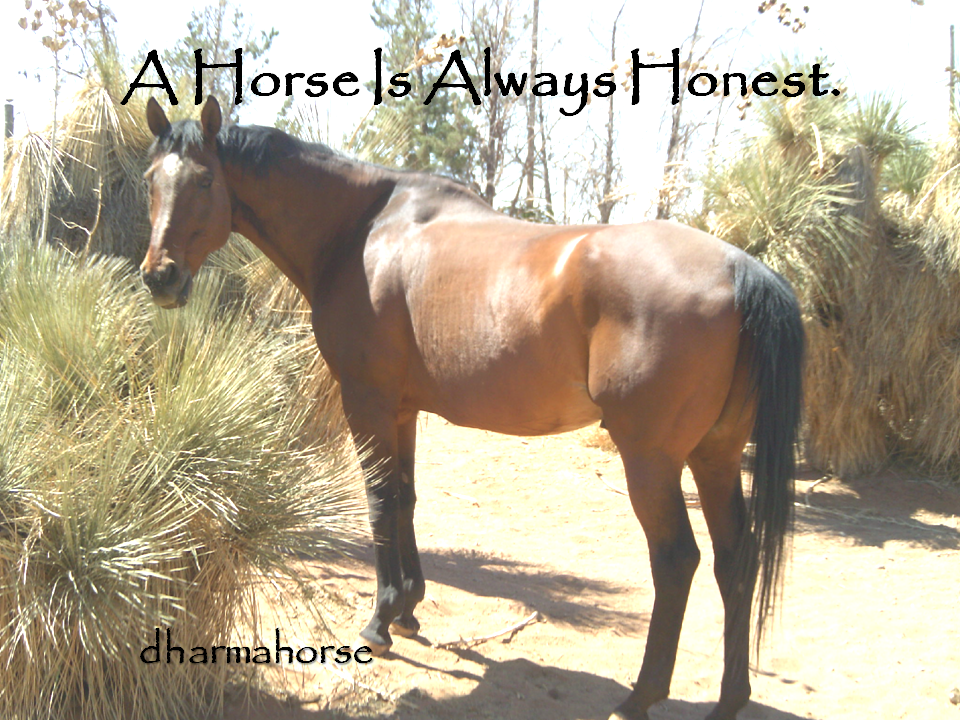
A horse is massive and fragile; steady and quick moving; brave and sensitive. They bring so many emotions and responses to a relationship with us and are always totally honest! When we find our “heart horse”, the level of trust becomes more precious than any jewel. To be trusted by a horse means that we are clear, honest and trustworthy because they see us through eyes of pure perception. We cannot hide our true selves from an equine.
It is difficult to describe properly, that sense of connection that is often instant and deeply personal. We aim to find it with our horses in the stable and under saddle. We hold that hope in our hearts to find it with another human. It is relatively easy to enter into with our dogs! To cultivate that bonded horsemanship experience is the only way to find one’s heart horse.
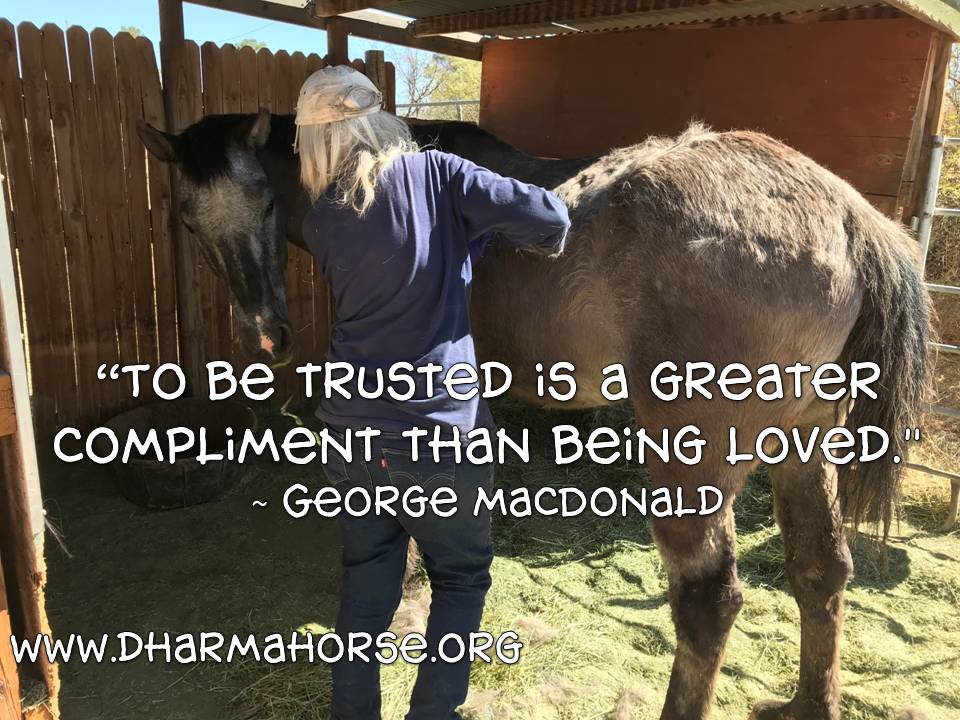
It is always a profound honor to find yourself trusted by an animal. Even more so than by another human because the animals are not swayed by our words or actions; they see our hearts clearly.
That space we can find with a horse where he feels or reads our thoughts and is responding to them effortlessly cannot be forced. To hug a horse is beyond satisfying; to be hugged by a horse is intoxicating. There are training systems that distance the human from the horse – he must “respect our space”, respect our boundaries… and some systems aggressively create a pocket of charged disapproval of any attempt at connection. Horses are smart. They figure us out. I would rather have my horse feel comfortable near me and back off if I tell him to do so rather than fear repercussions of a misstep.
I think that we need to also know that sometimes, a horse may not resonate with us personally. I have known students with horses whose personalities were mismatched but who found perfect new partners for their equines and themselves. There is nothing wrong with that. We don’t all fall in love with the same person, drive the same car, eat the same cupcakes – we can take our time finding an equine partner that fits us as we fit him or her. It is about the relationship, not about the breed, color, length of tail or size of the head.
When you feel that spark of recognition, of rapport and delight with another being, open yourself up to it and explore what possibilities exist for the pairing. I am able to adore all of the horses here, but I have a deeply personal, uncanny knowing and sweet rapport with one especially and I won’t say who it is. I have been blessed to have had several “heart horses” in my life.
It is amazing that we can love so clearly when we step away from the constraints others attempt to place upon us. Even in competition or during instruction, don’t let your wise knowledge of your own horse become muddied by the opinions of others. It is so much fun to love and be loved! And that has to be based upon the very personal rapport.
Our philosophy at Dharmahorse is based upon loving all horses in general and the Sanctuary horses in particular. We can expand that into educational outreach, to help people better care for and understand their horses; in turn, helping the horses to live better lives. We will never be able to save all horses in need. But, if we can offer the ideas, methods and techniques we use to benefit horses in our care, we might just advance the concept of loving horses enough to cherish them with good care and handling. Maybe Heart Horses are not discovered; maybe they are cultivated through kindness. Perhaps, the horse standing in someone’s backyard just needs the chance to know compassion so he can safely return the love.
Last year, I was gifted a “Caregivers Retreat” in Colorado through “No Barriers”. You see, I am my brother’s caregiver since his stroke in 2016. He is an amazing man. He worked hard to recover; to learn to cope with losing most of his sight in one eye, to learn to walk again… so many things he overcame.
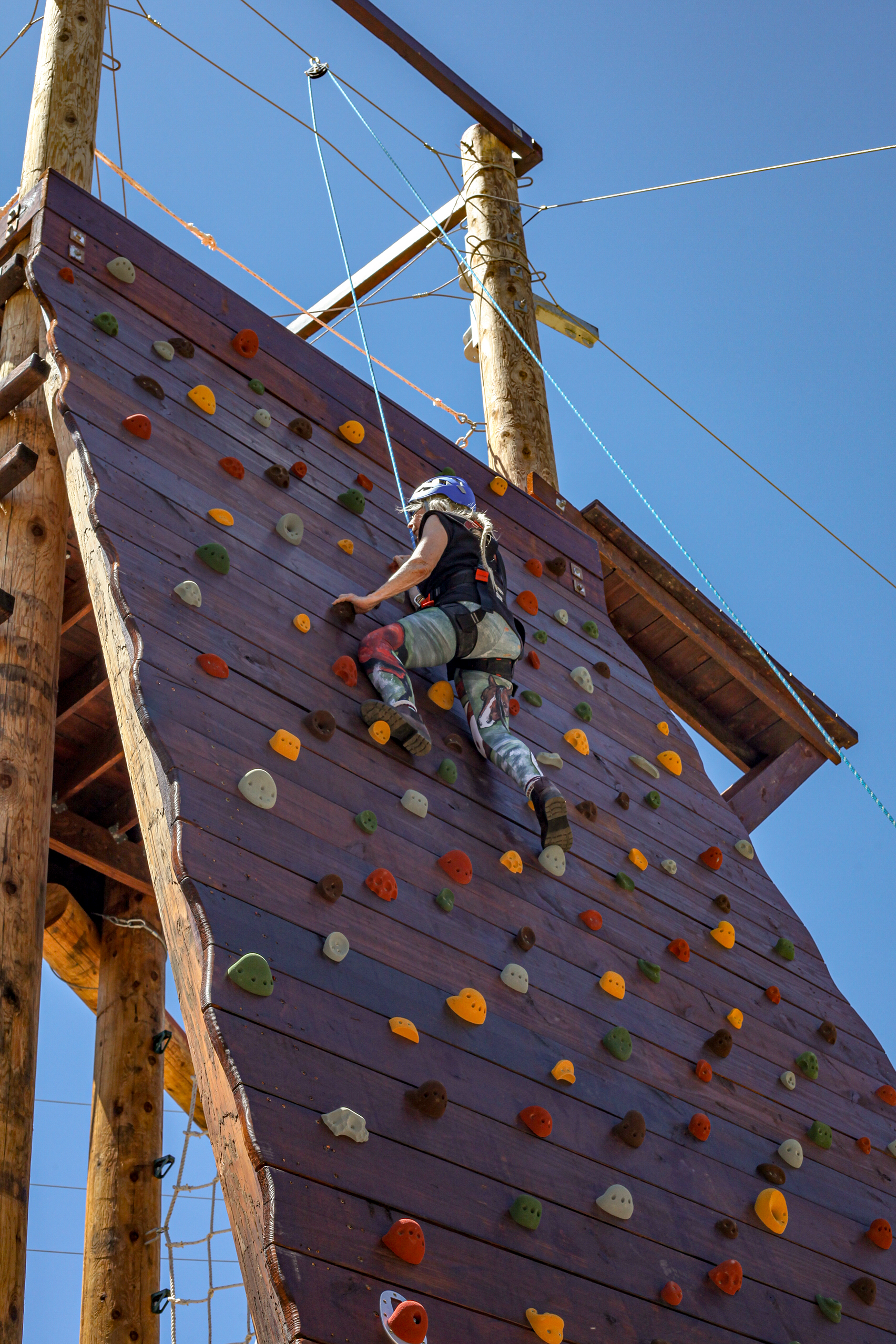
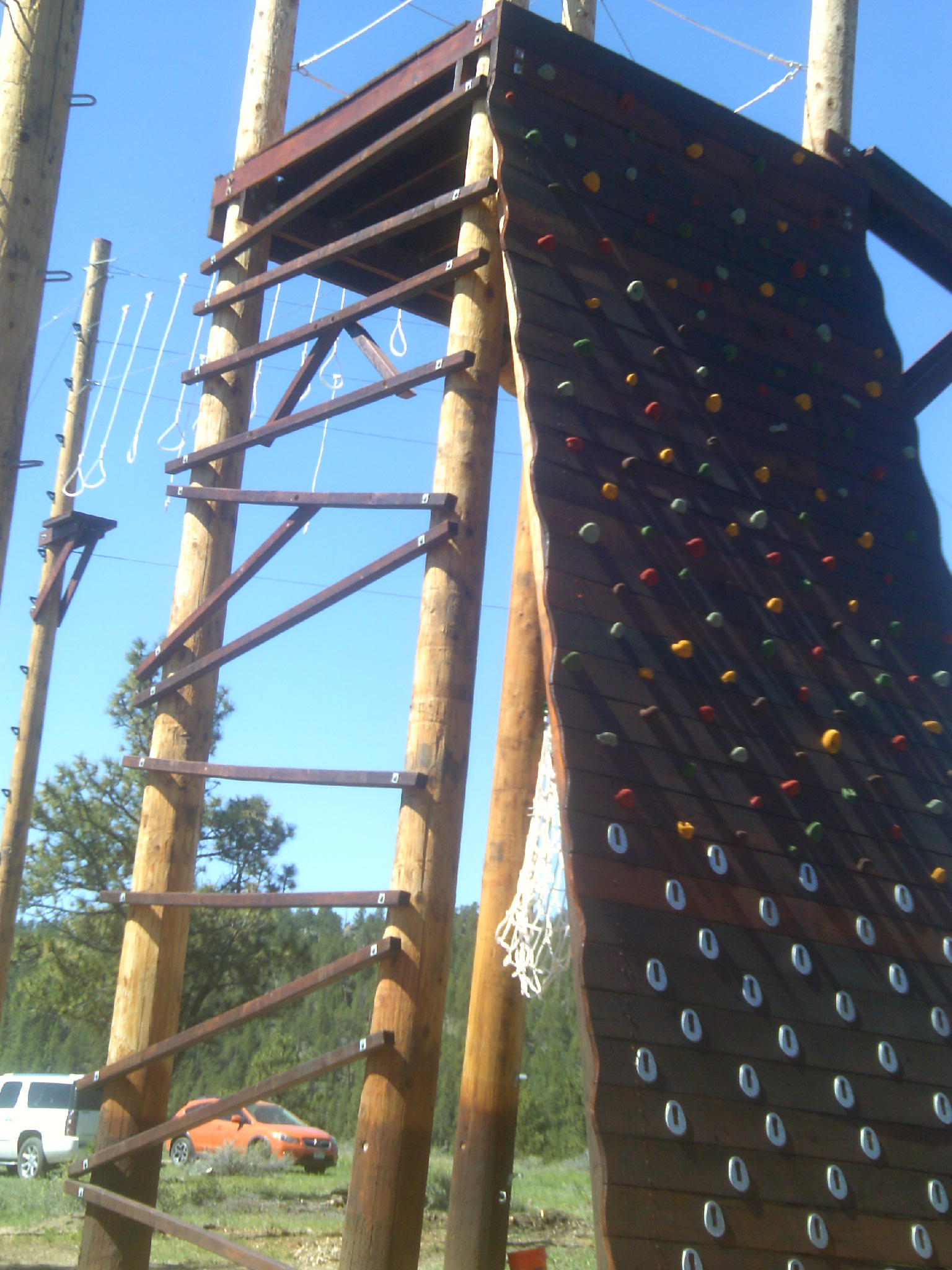
That Retreat was a life changer for me. I climbed a wall (I’m terrified of heights) with a “rope team”, not just on ropes to keep me safe, but of other caregivers cheering me on… we learned all about Rope Teams in life.
The Wall
It was surreal. Camping and hiking in Colorado (I used to live in Boulder), I was doing things just for myself. Mark and his team took care of the horses. Everyone checked on my brother, Billy. I had no worries. And I found my courage again, in ways I did not expect! I was there in the spring. I flew to Denver from Albuquerque to get there. I drove our truck to Albuquerque and parked it at the airport (No Barriers supplied my tickets, so I left from where they decided).
After a glorious and introspective few days, they got us all to the airport in Denver. With my backpack, purse and a tote, I found my way to the boarding area after 2 hours getting through a 1/4 mile long line for TSA. My flight was cancelled. There was no other plane to New Mexico for 3 days. As they tried to help me and I worked to not panic, I thought “anything to El Paso, Texas?” I had had to go out of the secured area – there was an El Paso flight in 10 minutes… I would have to go back through TSA… I was hyper-ventilating. The lady double checked and discovered the flight was delayed getting to Denver, I had 30 minutes!
I made it, barely, got on the smallest plane United has! It was a bumpy ride to El Paso, where Mark met me, got me home and then on a bus to Albuquerque to retrieve our truck!! I had planned to visit a friend in Taos, so I drove there (feeling like a zombie) and spent the night. Then, zombie-like, I drove home. Whew. Had I not just spent all those days building my courage and strength, I would have fallen apart.
Come summer, the opportunity for a scholarship for Billy and me to go to Estes Park for a No Barriers Summit was a miracle we grabbed with both hands! I had to drive us there (same truck) and it was 15 hours on the road with all the construction and city traffic along the way. We were knackered when we got there.
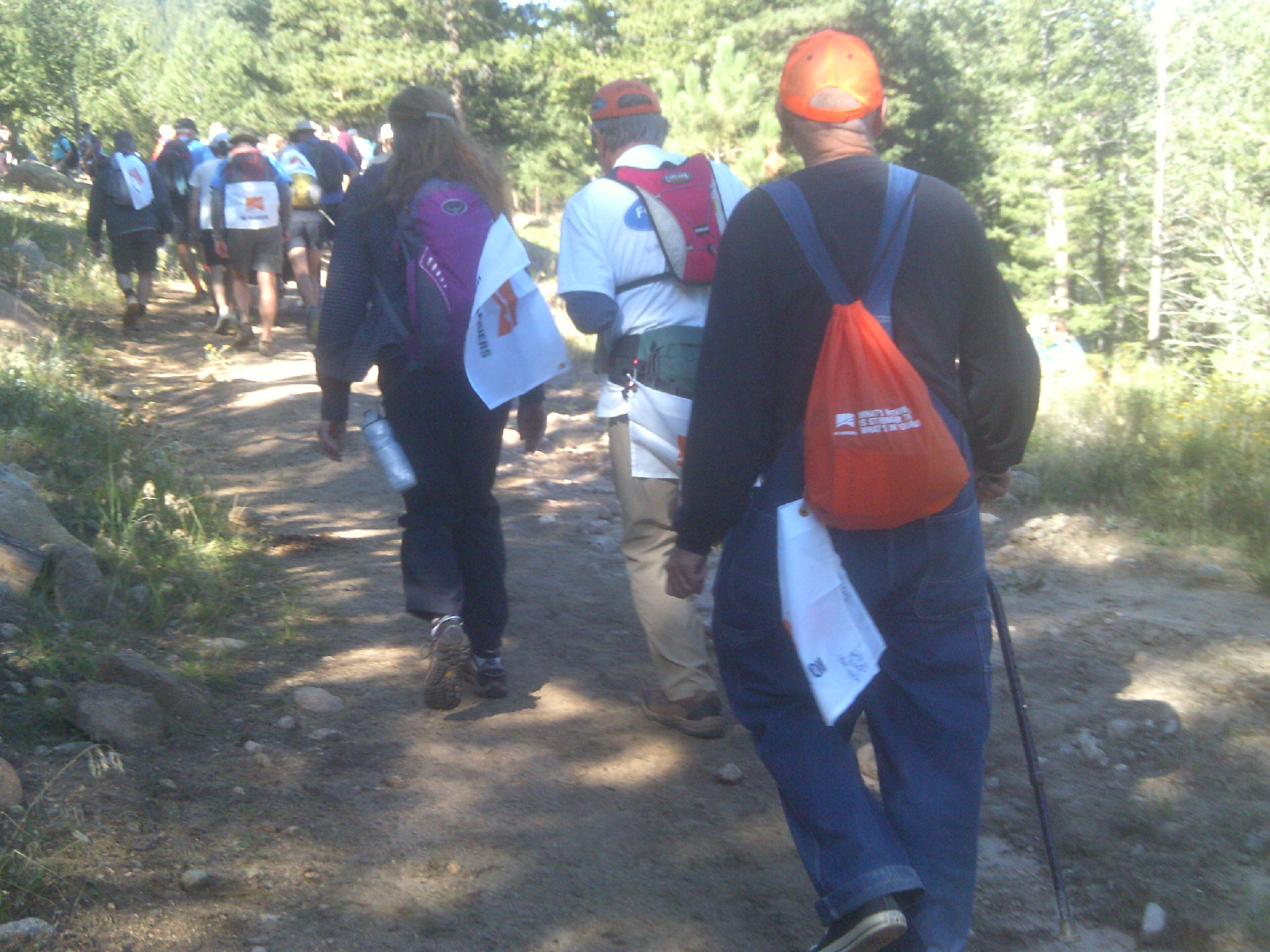
It was an amazing experience. I worried (too much) about Billy the first day and night – but he blossomed! He flew kites, he hiked a 6+ mile group hike (with disabled people like himself) the last day at very high altitude! I hiked it, too, all uphill. There was a lunch picnic after the hike, then we were on the road, me driving back to southern New Mexico.
Billy!
Traffic in Denver was awful. There was construction everywhere and it got dark quickly! When we finally got to Raton Pass, it was storming (huge lightning, hail, rain like someone turned on a tap) and the road was down to one lane with NO lines and no visibility. By the time we got down from the Pass, I was shaking badly. But we made it. Billy was the best “co-pilot” ever!
At a rest stop, still pouring rain, we sat and I caught my breath. I would not have made it without all the things I was learning from No Barriers. Billy said, “that was like watching a horror movie at a drive-in movie theater” It had to be scary for him! I burst out laughing!
It was more like 17 hours to drive home. Billy kept me awake (no small task at that point). It was possibly the best thing I’ve ever done in my life. And, that time with my brother was a real miracle. He was my Rope Team…
So, when I look at Dharmahorse, I see a Rope Team of helpers making sure these horses are safe and healthy. While Mark and I have the 24/7/365 responsibility, the Team we have here makes it all possible! None of us, in life, is facing challenges alone. If it seems that way, we just have to look around for the good people on the same path. I felt so different after meeting all the caregivers at the retreat. I could say anything… they understood. I wasn’t alone.
No Barriers says, “What’s within you is stronger than what’s in your way”, boy, did I learn that!
“Let the reflective nature of Equus bring insight into your own nature through simple, gentle contact. Horses offer an immediate, honest response to our physical, emotional, mental and spiritual states. This can often help us recognize patterns or actions in ourselves that do not serve our own causes, desires or wellbeing. As a species, horses have been tied to humanity for thousands of years. They have fought our battles with us, carried our burdens, plowed our fields and served as transportation and technology for every culture on the planet that has known them. Horses have healed us with their generosity, their gentleness and total honesty. Their reactions are always pure. Master yourself and a horse will always recognize it! The respect that flows between human and equine fosters clarity, consistency, honor and compassion. We can learn from horses just by being in their presence. And what we learn about ourselves can change our lives.” ~ Katharine
I’ve always had a tendency to walk outside barefooted. When I lived in Florida, a group of friends and I were walking barefoot along sidewalks one evening, between several stables and homes – we saw a fire in the distance and, in a bit of a panic, ran across two empty lots to be certain it was not a horse barn. When we found out it was a demolished shed, being deliberately burned, we started walking back, retracing our path.
As we got to the empty lots, we saw that they were covered (literally) in broken glass. Sparkling in the setting sunlight, we pondered how we had managed to remain unharmed – no cut feet on any of us. We found a new path back.
It made me think about walking on hot coals. I have never doubted that “mind over matter” is a real thing. Decades later, here in New Mexico, a riding student of mine went to a gathering where they actually did walk a long path of hot coals barefooted. They were prepared for the experience with meditation and breathing exercises. She said she did well, was amazed and unharmed, but, she had a hot coal get caught between her toes. When she told me that, I just knew, if I tried it, I would get a smoldering coal between my toes! I have not tried it… but probably would, given the chance!
My nemesis these days is the proliferation of “goatheads” since all the rain we’ve had these past months. They are sharp, nasty little thorns that feel venomous – after you pull one out, it can hurt for days. And I got one deep in my toe last week. My toe actually swelled! It just yesterday stopped hurting. Instead of hot coals, a section of goatheads to walk through barefooted would impress the patootie out of me!
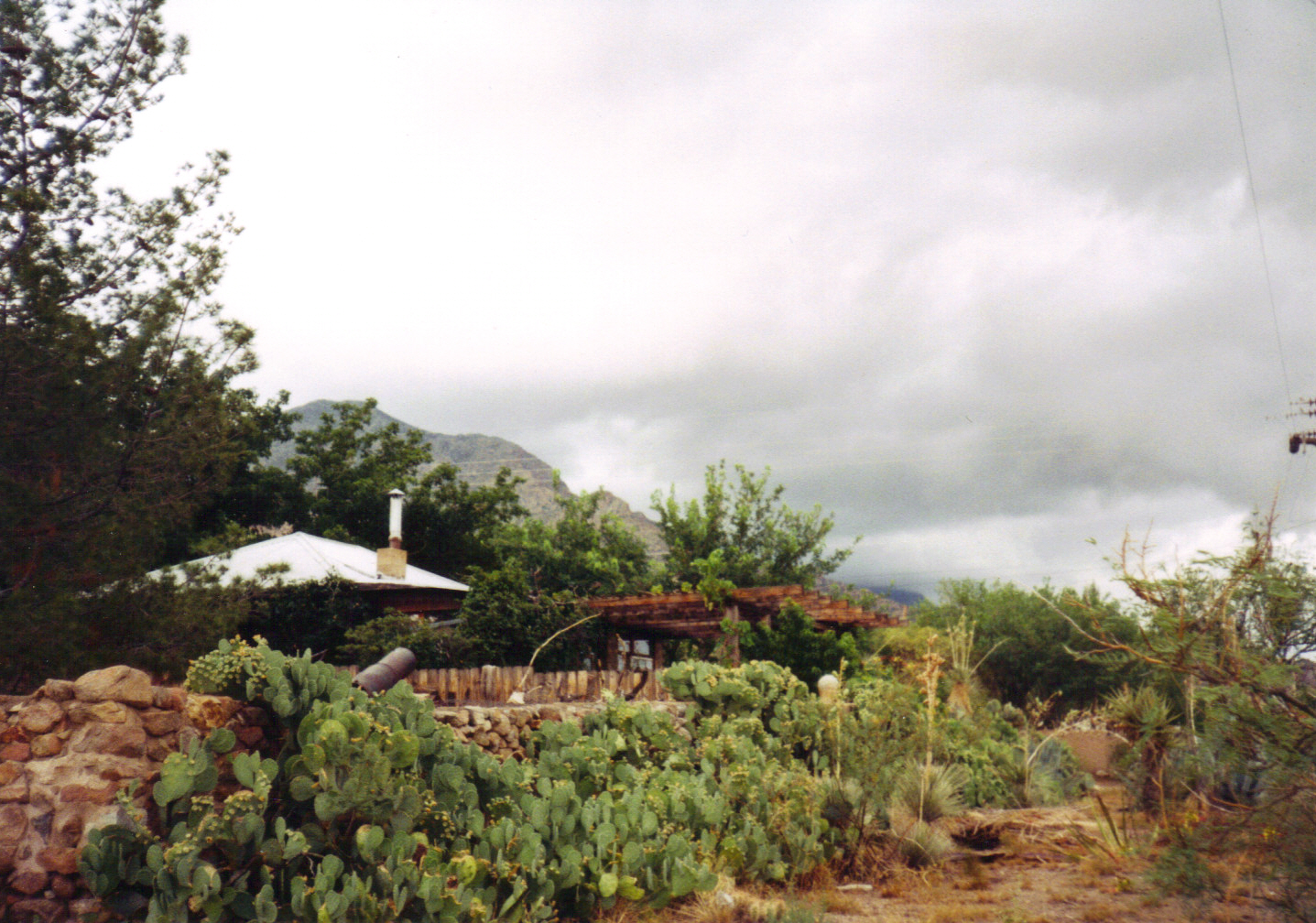
Rain rolling in
And going outside to check on horses barefooted has been replaced by my stepping out in socks (it’s been really cold lately). Now, the muddy color doesn’t wash out of my socks anymore.
And washing clothes (I’m a horsewoman) means checking pockets for hay and treats and nails I find on the ground (when they built barns years ago, did they just throw boxes of nails from the roof in all directions?)… cough drops and old tissues, these things never fare well in the washer or the drier. Yet, my best intentions are never enough. The drier vent screen tells the tale, always full of hay specks, candy wrappers and Kleenex fuzz. The alfalfa pellets and rusty nails stay in the washer. And I won’t even get started about being banned from Laundromats in the spring when horse blankets need to be washed.