I awoke this morning feeling overwhelmed. There is so much to do before the end of the month. I started thinking about who I really am… what I do. I am Gita’s eyes. I am my brother’s legs and his strength. My hands are for these horses; to feed and care for them (battered as they are, my hands are useful). My brain belongs to this Sanctuary, to figure what is needed for the horses and how to pay for it. I am Mark’s partner in this life… to be kind and supportive.
My soul belongs to me.
My mind works overtime, becoming twisted by things that go on in this world that I have no control over. My Buddhist life should help me maintain clarity through the muddied waters of life on earth, but somehow, I have forgotten that part of my being in the daily monotony of caring for so many. Certainly, I know that self-care must be part of my agenda. We all know that we can’t pour from empty cups. Rescuers and caregivers have huge cups to refill… all the time.
So I sit under the pine trees and watch horses eating breakfast. Touching the earth, I hear her saying how she, too, is a giver of care, a lover of all life, a rescuer of souls. Are we not all connected by the simple act of being kind? To each other, to all life, to this earth…
I used to care more about what I wore, how I looked, how others perceived me. Judgement swirls around us from sources beyond our control. Others see us through their own eyes. Suddenly I’m struck with “The Earth is my witness” and though the perception of this Sanctuary is important, I realize that those who truly see what we do are the ones who know us. I will never again be posh. My life is too busy and too important to worry about posh. Being overwhelmed has to with letting extraneous thoughts and outside influences intrude upon the actual need and focus of this life. I need to stop doing that.
We think about ourselves as stewards of these horses. Different from owners, we are committed to their care and wellbeing and what we can do for them; not what they can do for us. They are not objects. They are thinking, feeling beings with needs and opinions just like our own.
Whenever we take authority over someone or over a situation, we take responsibility as well. I grew up with bucket loads of responsibility and had to assert myself to have equal authority. The two go hand in hand from either direction and demanding “control” of someone’s life means we must be responsible for all aspects of their wellbeing. That is stewardship.
It applies to all animals. It applies to our family members. It applies to the Earth; to the land and all life on it. To be a good steward, we set our egos aside and focus upon the needs and wellbeing of those under our care. Sometimes we are the ones cared for. Sometimes we are the caregivers. If you have ever been in a position to need the help and consideration of another, your empathy is increased, and you understand that often tenuous feeling of dependence! If you have ever felt like merely an object, you know how offensive that can feel.
In order to be a good steward of our horses, we need to cultivate relationship with them. Unlike the motorcycle we can leave in the garage for weeks, then bring it out for a ride – our horses need connection to us (and others of their species) to keep mind and body healthy. The motorcycle doesn’t get stiff or sore; it does not worry about where you will take it; the motorcycle does not feel “off” that day (it has no feelings). The horse does. We need to be able to listen.
In my youth and young adulthood, I competed with horses. It was what one did. Horse shows were held every weekend in communities all over West Virginia, Virginia, Tennessee. Those of us who showed would be up all night before the show, scrubbing and polishing tack – the metal on bridles (and our stirrups) had to reflect light like a mirror. Leather had to gleam.
Days before a show, we would clip and trim hair from our horses. The day before we would bathe and cover the horse to keep him clean. Depending upon the style we rode, manes would be pulled (yanking out small amounts of long hair to get an even, thin mane suitable for creating the row of “cigarette” braids); the hair inside equine ears would be shaved away to “look tidy”. Whiskers would be shaved to the skin. By the way, hair in the ears keeps bugs out and whiskers are feelers that help the horse keep from bumping his face on objects. I even knew a girl whose mare could not be clipped (buzzing of electric clippers sent her over the edge), so she put Nair depilatory cream in the mare’s ears and shaved her muzzle with a razor). If we rode a style with a long flowing mane, we would keep it done up in long braids to prevent breakage and wash and condition it constantly – tails, too, everyone obsessed over long, thick tails.
Beyond what the majority of us did was the flashy 5 Gaited Saddlebred horse or the Open Walking horse crowd who kept their horses stabled in hoof pads, weighted shoes (or worse), in “tail sets” that held the tail’s dock up in an exaggerated way… I won’t go into other techniques to make the horse look animated and excited while in the ring.
So, competition horses lived a very unnatural life. And yet, many of us loved our horses dearly and thought we were doing right by them. The rider who would show up at a competition after pulling her pony from a field where he lived, brushing him clean and leaving him fuzzy had no chance of placing in classes.
But I remember those riders… their mounts seemed engaged, aware. They had alert expressions and seemed to genuinely enjoy being around other horses and doing something different. We all fussed over our riding attire as if we were brides ready for a wedding. Someone (usually our parents) stood by with rags to rub dust off of our boots and to brush clean our horse’s polished hooves. Our horses danced around anxiously; or became flooded and numb, accepting their fate… and we riders were either stressing out or had become, ourselves, flooded and numb.
When I had riding schools, I prepped my students and the school horses for an impressive “turn out” at shows. We were amazing. We were admired. I’m not sure now, in retrospect, how our horses felt about it all. I do know that I learned valuable lessons (and taught them) from that process. But now, running a Sanctuary and caring for horses from every imaginable situation (broken down from competing or racing; dumped in the desert; victims of hoarding situations; even beloved equines who could not be cared for anymore), I find that my ability to read how a horse feels has been honed to a sharp edge and I wonder about all the horses from my past and what they would say to me now. When we know better, we do better.
I see pain, struggle, stress and flooding in the faces of beautifully turned-out horses in ads and videos. I cannot “unsee” the distress on their faces. I see through different eyes after decades of learning from the horses. How they feel matters more to me now. And, to get their lives in line with Nature and to honor their species-specific needs has become a priority. I will never be the same person I was because I now see through their eyes.
Our interactions and ministrations in the care of a horse show him (or her) just what we believe he wants and needs. How can we be accurate in the assessment of equine requirements? Are we focused upon merely keeping him alive or is his life an extension of our own desires? Somewhere between assumptions/projections and minimalization will lie the truth of a horse’s needs.
He will not consider brass plated hinges and latches to be necessary. Confinement in a beautifully paneled stall, no matter how large, clean and “comfortable” we may consider it to be, will not be high on his priority list. The effort put into making stables that appeal to humans might not actually be in the horse’s best interest.
He requires forage, friends and freedom. A horse is a herd animal designed to eat small amounts of forage constantly while in motion. The effort we put into making his life fit our schedules, our needs, our lifestyle is not necessarily of value for his innate nature. Things like beautiful tack (saddles and bridles) mean very little to a horse… he just cares if it fits and is comfortable.
All the effort we might put into making his surroundings appealing to our own eyes might mean diddly to a horse if he does not have comfort, health and joy in his life. The extra effort of mucking a shavings-filled box stall won’t mean as much to him as the value of living a natural life in motion with others of his own species. We might work hard in our desire to provide for him. We might spend huge amounts of money on supplements and medicines to correct the imbalances caused by lack of exercise, improper diet (one that is not species specific) and/or lack of fresh air. The shoes applied to “correct” pathologies exacerbate those imbalances and keep the hooves disconnected from the Earth. A three- or four-hundred-dollar shoe job (or more!) is an expression of effort… the value is questionable when a barefooted horse becomes sound and comfortable with varied terrain, movement and proper diet.
Our horse care and management must be safe, simple and consistent. Fences need visibility and to be as safe as possible. If they are gorgeous, too, that’s great! As long as they surround an area large enough for real movement and enrichment. Shelters need to be accessible and sturdy. Feed and water containers need to be clean and safe. Beyond basics, the horse has no need for impressive features.
To me, a proper stable yard meets the horse’s needs. The horse is safe, comfortable, well fed (and properly fed), has companions, has joy, is not stressed, not pushed physically or mentally and is glad to see his humans.
I slept all day today. The entire past week was spent keeping our Sanctuary horses safe from the fireworks that culminated in last night’s Fourth of July “Celebration”. It felt like a week of trauma for the horses, for us and for our rescued dog who stayed inside the house, but still felt the ill effects of the nearby “bombing”. Each year the fireworks have gotten louder and last night I wondered about the decibels inflicted upon those close to the explosions. We felt the shock waves even inside buildings. It was a nightmare.
Twice a year (the 4th of July and New Year’s Eve) this abomination is allowed that terrifies animals, disrupts wildlife and assaults Veterans with PTSD. I cannot wrap my head around the advice that was posted on social media to “take your animals somewhere that does not allow fireworks”. That we could somehow gather up dogs, horses, cats and leave our homes for however long the barrage of flying fire missiles and earth shaking explosions lasted is surely a joke.
And during this period of weather warnings: Fire Weather; Excessive Heat; Dangerous Dry Conditions, the fact that fireworks were even allowed this year boggles the mind.
And this is nothing new. In the 1980’s I wrote an article for the newspaper about the misery of fireworks for animal owners. I interviewed a firework’s vendor who told me that selling them twice a year was his family’s year’s income. He made his money for the year by selling fireworks for a couple of weeks twice yearly. I’m sorry; I have no sympathy for such a situation. Considering the trauma inflicted by his “profession”, my first thought was “get a real job”.
I spent night after night this year making and feeding strong calming medicines to horses at two stable yards. I played calming music, had every light on at both places and walked from horse to horse giving extra hay and trying to soothe them, hour after hour. With pharmaceuticals for back-up (they all have side effects) in case of real panic, the monetary cost was substantial and there was always the danger of injury if trying to handle a panicked horse.
I know our neighbors are decent people. I realize they are simply ignorant of the chaos they inflict. But that doesn’t help me when I watch our 30 year old, blind mare (who was dumped in the desert to die and we rescued her) walk circle after circle nickering in fear.
A couple of Benadryl kept our sweet young dog from total panic inside the house and a steady stream of coffee, tea and protein bars kept me awake, alive to manage the situation each night. Why should I have to do this? Why should friends have to put Thunder Shirts on dogs, get tranquilizers from the Veterinarian and leave the TV on loud for their dogs and cats so other people can burn their money in backyard displays of shrieking, flashing and exploding nonsense.
I watched bats, lit by the floodlights, crashing into trees as the loudest explosions hit. I saw the confusion in the horses’ eyes as they cowered or ran in circles. What hell some of them went through. I say “some”, because we have several horses who are not frightened by the “celebrating”. They helped calm the terrified ones.
All of this baffles me because communities present large, professionally handled fireworks displays that anyone can attend. Backyard fireworks, to me, are akin to having “backyard Rock Festivals” or “backyard Motocross” and even those would be limited in duration! And they would be quieter!
Most people are drawn to horses. They are elegant beings who possess gentleness coupled with great size and strength. They can be dangerous to the inexperienced person; the inexperienced person can be dangerous to them.
When a horse lives in the neighborhood, he is a magnet to many. If you find yourself wanting to visit a horse that is not yours, ask his owner for permission to see him and never visit if the owner is not there.
You should never feed a horse you do not own. Horses have complicated digestive systems. They cannot vomit and they choke easily. If you think the grass clippings from your lawnmower would make a tasty treat for a horse, pony or donkey – stop and think again. Grass clippings are so fine that one mouthful could choke a horse to death. If the mown grass has been sitting for several hours in the heat, it will have become rancid and will likely cause a potentially fatal digestive disturbance called colic.
Horses love carrots and apples. Both contain sugars that are dangerous for a horse with metabolic issues (linked to insulin resistance). Letting a horse bite off pieces of a whole carrot from your hand could teach him to bite a finger off of someone else. Horses cannot see what is held by their mouths, they cannot tell the difference between a carrot and a finger until they taste it!
A whole apple offered to a horse can be grabbed and swallowed, which will choke him so quickly that he cannot be saved.
People foods can be toxic to horses. Any gas producing vegetables like cabbage, kale, broccoli, etc. will cause colic. Chocolate is dangerous as are many weeds that grow along ditches. To pull plants growing nearby and hand to a horse might poison him or they could have been sprayed with chemicals!
Even appropriate horse food can be detrimental if a horse is not accustomed to it. It takes 10 days to gradually change a horse’s diet; so to suddenly give him unfamiliar hay or grain can be damaging.
Going into a pen or field with a horse you do know puts you at risk. Horses are prey animals who react quickly when frightened and, while they will turn and run away (the flight instinct); they often kick out defensively as they flee. If a horse lands a kick on a person, the sheer force of it can break bones or worse! And flimsy footwear puts you at risk of severe foot injury should you get stepped upon.
A horse’s owner can take you in to meet their equine and her presence reassures that horse. Should the horse become worried, she will recognize that and keep you (and her horse) safe. Each horse has individual mannerisms and levels of tolerance that can only be perceived by their person.
Consideration and awareness can make you an advocate of horses. That neighbor with the beautiful mare will be grateful for your thoughtfulness in asking permission to pet, visit or feed her horse. And if she declines, know that it is just to protect her horse. They are complicated and fragile creatures.
Decades ago I made a pact with the Universe. Every horse who came under my “ownership” (stewardship) would have the best life I could provide and a new good home if that was what the future brought for them. I kept a lot of horses from birth to death, but many more horses and some mules moved along to loving homes for a plethora of reasons. My brother and I made a list in the ’90’s of the horses we had owned – after remembering the names of 300+ horses, we stopped counting…
That sounds like we were turning horses over “right and left”, but the reality was, I bought, trained and sold dozens. I ran three schools of horsemanship from 1973 to 1997 and continued to teach after that. Dozens of school horses worked with me. Sometimes, a better type of home was found for some. At times, a horse proved to be more suited to “family life”. I rescued horses from dire situations… I started my 4th school in 2010 here in Las Cruces and it morphed into this Sanctuary.
During all those years, I made some mistakes. One time, when I had to move to Arizona, I gave a horse I had raised to a lady I thought would be the perfect home… she could handle him, I knew that. He was complicated because he was orphaned at birth. They are never easy because they model after humans instead of other horses.
When I returned to New Mexico, I learned that this horse had been for sale, had not sold and was going to auction! Friends bought him to save him. He was difficult for them to handle, so I found a woman who I had worked with in the past who had known and loved him. They gave him to her, and it was a perfect match. He was safe.
We do the best we can. I learned that a horse sold for a lot of money would be “worth” more to the buyer than a horse given away, no matter the circumstances or the horse’s abilities. I learned that people’s lives can change and their priorities change. In the rescue world, we can adopt out lots of horses to make room for more intakes – but making sure the adopted horses continue to be cherished isn’t easy.
We all have contracts that stipulate an adopted horse is to be returned to us if it doesn’t work out. I am so grateful that our adopters have honored that. But many times, for friends of mine, it has not gone that way.
At Dharmahorse, we have so many senior and special needs horses. They stay with us for the rest of their lives. Of course, that means they die here. They are cherished and cared for – sometimes in heroic ways – through their last months, weeks, days… even hours. Crickey, it’s not easy. But I’ll tell you what is harder. It is much more painful to learn of a horse who had been in your care who was ridden into the ground, ignored, brutalized or left to suffer. No matter how you try to keep tabs on them, horses can fall into at-risk situations in the blink of an eye. So, these beloveds stay with us. They stay as long as the quality of their lives is good and their day-to-day existence is worth living. If a rescued horse had been dumped in the desert, starved, brutalized or injured, to put them at risk of falling into that same situation would be unconscionable!
Decisions are very much made “in the moment”. The passing of a resident (the last euthanasia’s here were horses aged 35, 42, 40 and 31) will make room for an equine who needs us. And intake is decided from a 2-page list of criteria… and a Board of Directors meeting, even if it has to be virtual.
Rescue/Sanctuary isn’t easy. Sometimes we are a “nursing home”; sometimes we’re hospice. Always, we are home for these horses.
Horses learn to anticipate movements, transitions and such when we are riding. They anticipate places on the trail where scary experiences have happened to them. They anticipate being fed or turned out at specific times. They are creatures of habit.
We can use this to help the horse in his schooling. And by understanding his need for routine and the way in which he forms habits through anticipation, we can avoid habits that we don’t want him to manifest. We are responsible for the habits our horses form because they are either learning or unlearning.
Under saddle, we can use “props” to help channel the horse’s energy and keep his attention. Soft plastic cones work well. I buy inexpensive ones in different colors (to help my human students) at a soccer supply store.
So if you have a horse that is nervous or distracted about riding out away from the stable, start teaching him to do serpentines around six cones in a line at the walk. It helps to have an assistant on the ground, but you can do this alone with preparation ahead of the ride (and two sets of cones). I used this exercise with a student whose horse was terrified by a neighbor’s garage door opening just as she rode him out of her gate! She was also frightened by the experience.
When your horse has become very calm about the cone serpentines (over several days) and finds it habitual to focus on them, put the cones in a similar line outside of the stable on the trail. Go a very short distance at first. Walk the horse on the same serpentine around the outside cones.
In time, you will have your assistant pick up the first cone (nearest home) and take it to the end of the line (furthest from home) while you continue walking around them. You will continue this exercise as long as the horse remains focused upon the cones, the serpentine and your aids.
If he gets distracted, make the figures smaller or more complicated and do not extend the cone line any further out. You will do this quietly over a long period of time. The horse becomes complacent about the whole thing, and you can eventually set the cones in a line way out from the home and ride to them.
Your horse anticipates the serpentine when he sees the cones. In this way, his energy is focused upon the turning movement. You are using his anticipation of the quiet figure to defuse his nervousness. It will also help a timid rider keep her aids on the horse when riding out.
Cones can be used to help horse and rider with spirals at any gait. You need at least eight cones. Set them in fours at the “corners” of the concentric circles of the spiral: you will ride outside of the main four cones (I call this the “large” circle), in between the path inside of the main cones and the smaller circle created by the other four cones (this is the “medium” circle), and the “small” circle inside the last cones.
If each group of four cones has its own color, that helps the rider.
If your rider starts riding squares instead of circles, add more cones to actually shape the circle for her. You can ride large, then medium, then small to spiral in. Then ride small to medium to large to spiral out. While the spiral itself may not step as much laterally as it will later without the cones, getting this exercise accurate in its shape and concept is so much easier with props.
I have a student whose entire property in on a slope. She is either riding uphill or downhill. She has long, wonderful sand arroyos where we place pairs of cones (just like empty jump standards) randomly through the area so that she and her horse must focus on the middle of each cone set and ride, at each gait from one to the next. This particular exercise helps her with her youngest horse’s canter work. He maintains his rhythm and impulsion better by having to focus on the next “obstacle.” She does this without the lead changes right now, but they will come next; first simple changes and, later, flying changes.
We do leg-yield zigzags and half-pass zigzags up and down the arroyo at each gait. This establishes much needed balance and concentration for both horse and rider.
Another exercise with cones is to create a square with a cone at each corner. You can rider into this cone square at each gait, halting within it. Your horse will anticipate the halt and become more focused upon your aids. The square can be the center of your figure-eight (two circles connected at the middle) and, in this way, you will work the horse equally to the right and to the left. You are using the props to help teach the horse to listento your aids. He will learn that something is going to happen within the cones and will get ready for it with you.
After your halts become soft and even, ask for only half-halts with a strong driving aid right after. Your horse will learn to re-balance himself easily from the half-halt.
When your horse begins to anticipate too much, you change tactics and begin to leave him guessing. You will ride past the cones, ignoring them. You can do a different transition each time you pass between cones. All you have to do is use the horse’s habit-forming nature to help him learn and be on guard against habits that you don’t want him to have.
Anticipation is the very reason a horse can become so light and so tuned to the rider’s aids that he appears to move of his own volition. It is his awareness of the subtle shifts of his rider that lightens him. But to get there, the rider must be consistent and every movement she makes must have meaning to the horse. Otherwise, he learns to ignore everything but the most blatant signals.
Our horses rely upon the foundation of healthy hooves in the same way that a building relies upon its foundation – without a good one, everything above is compromised.
The hooves, like all body systems, are created from the foods ingested. Certainly external forces are at play as well, but, without the complete nutrition needed the hoof cannot meet these forces with strength and flexibility.
Horse feeds came about at the same time with the same philosophy as livestock feeds which were designed to create muscle and fat for meat production. The goal was not the consumption of horses; it was the feeding of muscles and creation of fat layers and slick coats, along with energy for working in fields and on roads. Horses did not live very long and a preponderance of draft blood made for larger, better equipped hooves as foundations.
Our horses now are family members living longer lives, often with smaller hooves from the breeding of lighter types for sport or show. While proper farriery or trimming are absolutely essential – the creation of the hoof structure, strength and health will be determined by diet.
The horse, being designed as a browser/herbivore requires the high fiber diet filled with herbs and forage that Nature provides (we can provide this, too!). To “feed the feet”, we need to supplement the grassy pastures and/or hays with herbs and foods that support hoof health by providing minerals, amino acids, enzymes and safe lipids (fats).
To process and extract the components then provide them in a bag of “complete feed” can often corrupt the very nutrients that are desired. Heat destroys nutrients and most processed foods are created by steaming or cooking. Chemical extraction is used to isolate many nutrition oils before they are blended into feeds and the result is a less digestible lipid with potential residues of the extracting agent. Just as processed foods leave us feeling hungry because we’ve eaten “empty calories”, the horse will feel undernourished and seek roots, barks, even eat dirt in an effort to find what his body craves.
Foods that are grown with chemical fertilizers, pesticides (herbicides or insecticides), or are genetically modified present health problems that may show up dramatically in the hooves. The hoof depends on proper blood circulation and nutrient availability to keep the multiple layers of tissue intact. This laminated structure holds the bones within the hoof and lower leg at precise angles. Since our horses walk on “digits” – their legs corresponding to one of our fingers – anything out of balance degrades the entire structure and creates pain.
Humans will show traces of toxins or deficiencies in the growth, color, shape and structure of their finger nails – the cutaneous structure of the horse’s hooves is the same and serves as an indicator in this same way. The choice of organic foods whenever possible will help lessen the body’s exposure to possible toxins.
My personal belief is in simple solutions and simple, nature based practices with horses. Of course, we need brilliant surgeons for injuries; experienced practitioners for diagnosis and allopathy to assist with overwhelming symptoms – but it is the body itself that knows how to heal and what to do with the nutrients we provide!
Foods that Feed the Feet:
A quality grass hay or pasture source is the base of an equine diet.
To this base, a legume hay or pellet may be added such as alfalfa – Medicago sativa – (Lucerne) for gestating, lactating or growing horses. A 10% to 20 % ratio to grass is a safe margin for the addition of the rich legume. It will add protein, calcium, biotin, silica and vitamin A (as well as many trace elements, etc.) to the base diet.
Sea Vegetables are supreme hoof support nutrients. Kelp – Fucus vesiculosis – provides over 30 trace elements and iodine, calcium, magnesium, potassium, silica, sulfur, iron and vitamin K. One teaspoon daily of powdered Kelp can be added to a bucket feed (of water-soaked wheat bran/pellets/beet pulp or specially blended senior feed or grain combination for the hard working equine) to nourish hoof health and growth (use ½ teaspoon for youngsters under 2 years old).
Rose Hips – Rosa species – are a good source of Rutin, Vitamin C, Selenium and Manganese. While horses do synthesize vitamin C (their milk is the only source of C for Mongolian nomads); it is a water soluble vitamin that can be used up quickly during stress or illness. The bioflavinoids and vitamin C are required by the body to strengthen capillary walls, clear edema and maintain blood circulation – essential things for hoof health, laminar health. Use one tablespoon daily.
Flaxseeds – Linum usitatissimum – are full of valuable Omega fatty acids. It is the Omega 3’s that are most nourishing and abundant in Flax (Omega 6 is often inflammatory and can be detrimental especially during injury or laminitis – corn oil has Omega 6 fatty acids). Flaxseeds should not be fed whole – they can be gas producing in the gut. Ground into meal, pressed into oil (not chemical solvent extracted) or boiled into jelly; flaxseeds will increase the strength and suppleness of the hoof wall, nourish collagen production, maintain moist shock absorbing properties of the hoof capsule and add multi amino acid proteins to repair the wear and tear of the entire hoof. You can feed up to one ounce of oil daily; mix the meal with water into a mud like consistency (building up to 8 to 12 ounces of meal over a 10 day period) with wet wheat bran (when phosphorus is needed) or soaked pellets or beet pulp; or use one handful of seeds to a pot of water, soaked overnight then boiled for one hour to make a thick jelly. These ratios would be per horse, per day except for the jelly which can be fed 3 to 4 times a week.
Nettles – Urtica diolica – when dried (the herb leaves are dangerous fresh as they “sting” the skin and cause histamine reactions!) can be fed, one handful dried leaves to the bucket feed or made into a tea, per day per horse. They are full of silica which holds intact the structure of all skin, nails, hair, hooves and claws. Nettles are rich in iron which creates hemoglobin, the oxygen carrying property of blood. This iron is organic – an inorganic iron supplement has been proven toxic to fatal. Copper is also present in nettles and required along with the iron for support of circulation and nerve/muscle fiber functioning. Nettles aid hoof health by also strengthening nerve endings and receptivity.
Fenugreek seeds – Tigonella foenum-graecum – are rich in Lysine (amino acid that maintains normal cell growth, regulates pineal and pituitary glands and is necessary for formation of collagen in connective tissue – lysine is necessary for all amino acid assimilation; the building blocks of protein!), vitamin A and vitamin D (it compares to fish liver oil, an animal source not recommended for herbivores). Fenugreek internally and externally aids in the release of abscesses. Feed up to 1 tablespoon daily.
Black oil sunflower seeds and pumpkin seeds are rich in oils, vitamin E and minerals as well as the amino acid Methionine (essential to hoof health, it is sulfur based to protect and maintain the integrity of skin, coat and hoof). Sunflower seeds with hulls can be fed from 1 to 2 cups daily; hulled – feed ½ cup. Raw, dried pumpkin seeds can be fed up to ½ cup daily. They also have anti-parasite properties and are prostate “friendly” (male horses do have prostates!).
The horse on fresh pasture receives abundant enzymes. A horse with no fresh foods in the ration will need supplementation of enzymes for proper digestion of all the other good foods provided. Enzyme rich, fresh additions can be yams, carrots, bananas, oranges, fresh parsley, peppermint, garlic and/or papaya flesh. If your horse is laminitic, IR or Cushinoid, avoid the fruits and roots with sugar content.
“Feed the feet” and your horse will reap the rewards with better health and soundness.
Bruises are a fact of life for horses and horse people alike. A bruise is an area beneath the skin where trauma, usually from a blow, stresses and breaks vessels allowing blood and serum to leak into the surrounding tissues. Inflammation sets in to supply fresh blood and often, to act as a natural “splint”, kind of stabilizing the area. All of these occurrences cause localized pain!
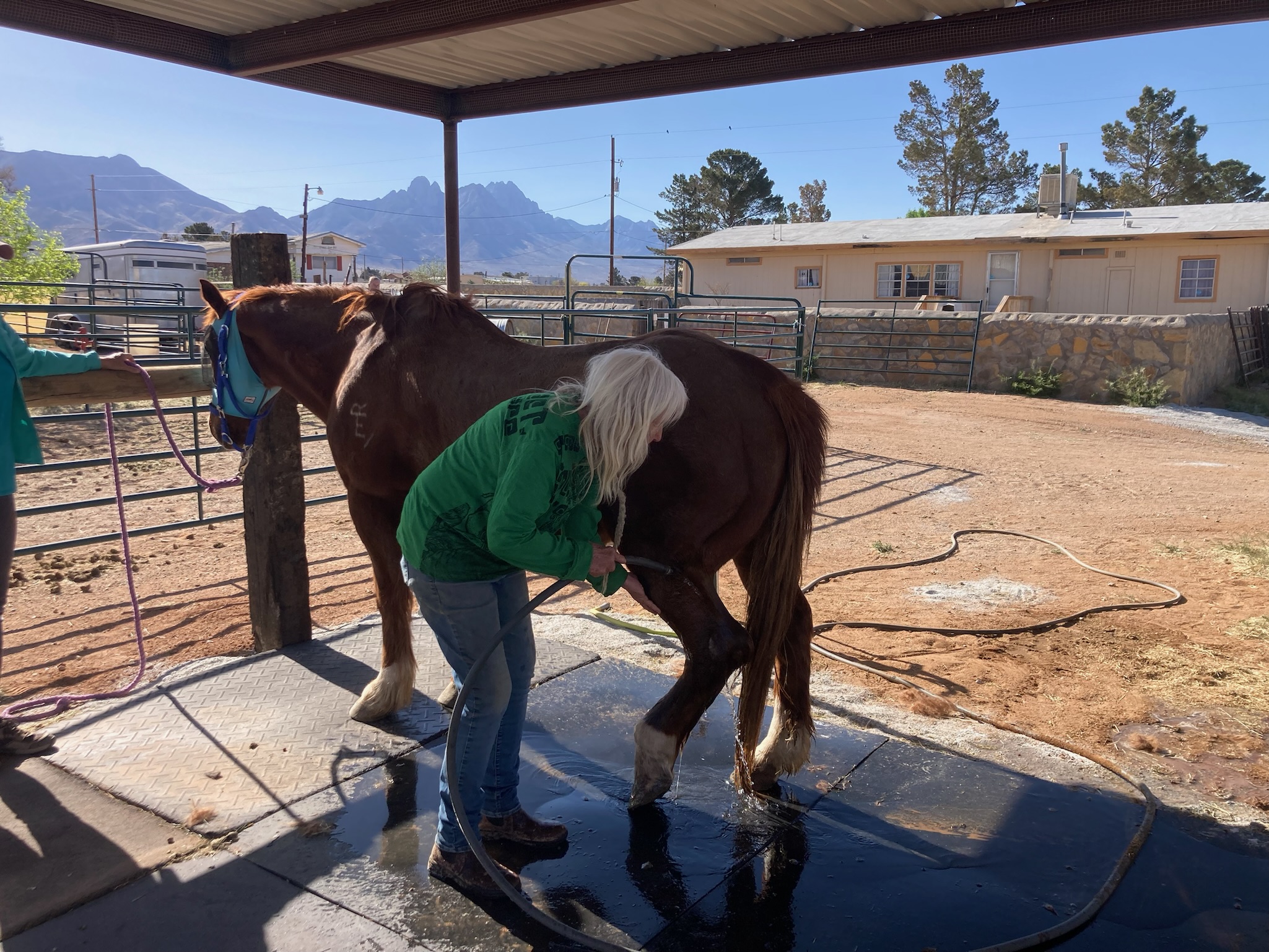
Upon immediate injury, the application of cold will lessen tissue damage and reduce swelling. For horses, bags of frozen vegetables, long “ice pop” frozen sweets or simple cold water from a hose will cool the area of injury. At the time of the bruising, a dose of Homeopathic Arnica orally every 15 minutes for a few hours, then a few times daily can bring the damage to a halt. Arnica gels, ointments and sprays work wonders externally.
The herb comfrey is an amazing healer for bruises. The root, boiled in water, makes a strained liquid that can be applied every hour to an injury (cold for a new bruise, warm for an old injury site). I have used comfrey for catastrophic injuries of horses and had such success that even Veterinarians were impressed.
The equine hoof has a propensity for bruising because of its small size in relation to the bulk and the weight it carries. A bruise to the hoof can be helped by the oral dosing of Homeopathic Arnica immediately. I carry the pellets on trail rides in case a horse becomes sore-footed on rocks or hardened paths.
A bruised hoof will benefit from soaking in warm epsom salt water. Most of our horses here at Dharmahorse Sanctuary will stand with one hoof in a tub of medicine – Majic would stand with all four hooves in tubs. The epsom salt water will draw pain and inflammation away from the hoof and the magnesium reduces pain. After the soaking, I will cover the bottom structures of the hoof with pure, strong iodine. This is all repeated three times daily until the horse feels relief.
There are pain killers that can be administered to the injured horse (talk with your Veterinarian) and there are herbs that will work in anti-inflammatory and analgesic ways also. These types of herbs that are safe to feed to most horses (do a test with a small amount at first) are: Meadowsweet, White Willow Bark, Devil’s Claw, Yucca Root, Turmeric, Comfrey Leaf in small amounts and Gotu Kola.
When I think a horse might be at risk of hoof bruising, I will put on a hoof boot to provide protection. If a horse has weak hooves, we will feed Methionine, Biotin, Lysine, Kelp and Rose Hips to strengthen the hoof structures. For protecting a horse’s legs, there are an assortment of sports boots and “bell” boots and large shipping boots to cushion any blows that might occur while riding or hauling or when turned out for a run.
And for any of us who receive a bruising blow or injury, the first step is to apply ice; second step is to protect the area from further damage; third step is to provide systemic healing through herbs, Homeopathics and essences that support the body’s healing rather than masking the symptoms.




 Stablewomen